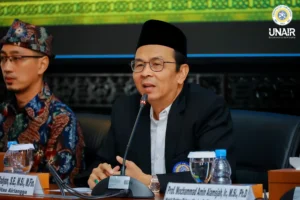


UNAIR NEWS – As part of 41st Anniversary, Faculty of Social and Political Sciences (FISIP) Universitas Airlangga held the International Conference on Contemporary Social and Political Affairs (ICoCSPA) 2018. The fourth conference had ” Global Digital Age ” as the theme.
Being held at Santika Premiere Hotel Ballroom, Gubeng, Surabaya on Monday, August 13, the conference presented Prof. Ronald A. Lukens-Bull from the University of North Florida who spoke on Digital Religion, Fanaticism & Terrorism, Prof. Cheryll Ruth Soriano from De La Salle University who spoke about Digital Labor Solidarity, Prof. Ariel Heryanto from Monash University who discussed Social Media & Identity Politics in Indonesia,and Prof. Henry Subiakto of The Indonesian Ministry of Communication and Informatics which promoted Indonesia Internet Policies.
After the presentation at the first session, the press was allowed to ask further about the presentations at the conference. In front of the press, Prof. Cheryll Ruth Soriano from De La Salle University revealed many things about solidarity of the digital workforce that is increasingly massive in the era of globalization. For her, it is needed to grow new power and become one of the things that determines the social and political direction.
“Interaction in the main media, this is a way to facilitate interaction between actors of digital practitioners,” she explained.
The next speaker, Prof. Ariel Heryanto gave several explanations about the central role of media in guarding each period of time. In fact, he added, the existence of the media has contributed greatly to the independence process of Indonesian people.
“So, long before the term hoax became public discussion, it actually existed. It’s just in different forms and terms, ” he explained.
Meanwhile, as the Chairman of ICoCSPA 4th FISIP UNAIR Committee, Puji Rahayu, S. Sos., M.Com ., said that the theme of digital technology globalization is a hot issue to discuss. In addition, according to her, the current digital era has both positive and negative impacts.
“In a global era like today, digital technology provides colors for various issues, such as religion, terrorism, labor, and so on,” he explained.
Author: Nuri Hermawan