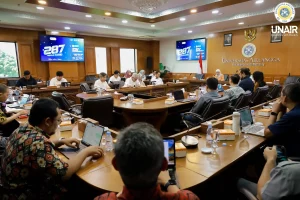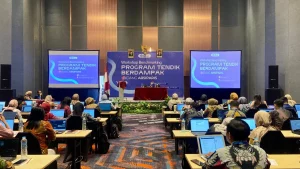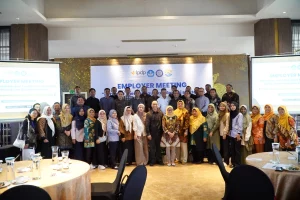


Faculty of Law, Universitas Airlangga (FH UNAIR), in collaboration with Panjab University, held a Virtual Joint Lecture Class on Counter-Terrorism Laws in India and Indonesia on Friday (21/10/2022). The Joint Lecture Class invited speakers from UNAIR Faculty of Law academics and the University Institute of Legal Studies, Panjab University.
Prof. Dr. Shruti Bedi, an academic at Panjab University, Chandigarh, India, presented material on Terrorism Under The Indian Counter-Terrorism Law. Prof. Bedi said that since 1947 when British colonial rule ended, the British divided the territory into countries involving India, Pakistan, and China. India claims the entire region as its sovereignty but controls only half of it. Pakistan controls one-third of the land, and China controls the rest.
“Since 1980, the area has been home to many militant groups. Experts say these groups have a wide network of support in Pakistan,” explained Prof. Beddy in English.
Several organizations banned in India because they are suspected of being terrorist organizations are Jammu and Kashmir Islamic Front (JKIF), United Liberation Front of Assam (ULFA), Khalistan Zindabad Force (KZF), and other organizations. According to Article 15 paragraph (1) of the Unlawful Activities Prevention Act (UAPA) 1967, whoever commits an act with the intent to threaten or may threaten the unity, integrity, security, economic security or sovereignty of India or with the intent to commit terror or is likely to commit terror against persons or any part of the people in India or in any foreign country by using bombs or dynamite, apprehension through criminal force, and/or detaining or kidnapping a person is considered to be committing an act of terrorism.
“India made amendments to the UAPA in 2019, empowering the central government to designate a person as a terrorist if found to be committing, preparing, promoting, or being involved in acts of terror. The central government can designate someone as a terrorist by notifying them in an official gazette and adding their name to the schedule supplemented by the UAPA Act. The government is also not required to allow individuals to be heard before designating them as terrorists,” concluded Prof. Bedi.