
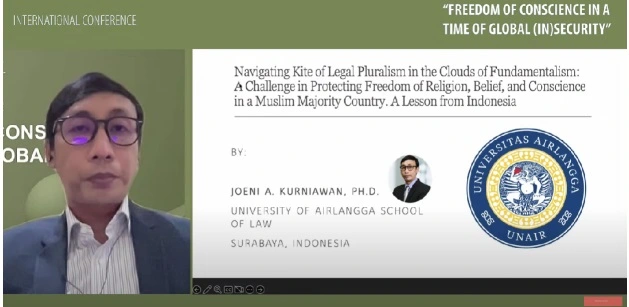
(30/4/2023) | Several lecturers at the Faculty of Law, Universitas Airlangga, recently presented their research results abroad. This time the research was presented by several lecturers at the “International Conference: “Freedom of Conscience in A Time of Global (In)security” which was organized by Mykolas Romeris University, Lithuania on Thursday (27/4/2023). Lecturers who participated in this conference seminar included Joeni Arianto Kurniawan, S.H., M.A., Ph.D., Iman Prihandono, S.H., M.H., LL.M., Ph.D., and Ekawestri Prajwalita Widiati, S.H., LL.M. The lecturers brought different themes to the conference. One of them is the research presented by Dr. Joeni entitled “Navigating Kite of Legal Pluralism in the Clouds of Fundamentalism: A Challenge in Protecting Freedom of Religion, Belief, and Conscience in a Muslim Majority Country: A Lesson from Indonesia”.
Through his presentation, Dr. Joeni explained that because Indonesia is a country that has the largest Muslim population in the world, Islamic Fundamentals arise. Fundamental Islam is an ideological set that opposes modernity, liberalism, and critical interpretations of Islam, makes Islam an ideology, and implements Sharia Law. A strong history of its existence also supports the emergence of Islamic Fundamentals. One of the clear proofs of the Fundamental Sililaan is the existence of Article 28 Paragraph 2 of the Constitution, which states that religion is above humanity and the first Pancasila precept which reads “Belief in One Supreme God”. This Islamic fundamentalism caused several problems, such as the prohibition of the spread of Shia and Ahmadiyya Islamic beliefs, the conviction of Basuki Tjahja Purnama for religious insults, the implementation of punishments according to Sharia, and many more.
According to Dr. Joeni, Article 28, Paragraph 2 is a misconception that must be changed. Why? Because the ideology is contrary to the conception of a liberal state. He said, “There is no provision that explicitly says that there is a guarantee of freedom for someone in religion,” This is because some religious sects are still prohibited. Even declaring themselves as non-religious people is still contrary to the article. Whereas supposedly, the intention of liberalism here is to free the choice of religion according to the preferences of every person in Indonesia. Therefore, Indonesia is more inclined to the title of a religious state than a secular state. Because if Indonesia leans towards the title of a secular state, then there will be no article above, no term “recognized” religion, and no law on religious harassment.
To fight misconceptions from the field of law, implement translation proviso or concrete translation provisions so that the law becomes clear and use the Intercultural Law approach. But these methods are still being repelled by existing legal positivism and the Islamic Fundamentals themselves because Indonesia is a country which, according to Menski’s Kite of Law, has “kites” which are still based on Islamic law. We should use Legal Pluralism which consists of Natural Law, Society, International Law, and State Law.
In closing, Dr. Joeni said that Indonesia should be proud of its identity as a country with the largest Muslim population because Islam is a religion that upholds diversity. However, fundamentalism is an obstacle to achieving diversity, and the “solutions” above show that liberalism and secularism are essential “tools” to combat fundamentalism. The principles of liberalism and secularism are elements of Islam, but fundamentalists try to hide this fact by contrasting elements of Islamism with liberalism and secularism.