

UNAIR NEWS – Faculty of Veterinary Medicine (FKH) Universitas Airlangga held International Community Service 2018 to Blitar District. It is the annual work program of Student Executive Board (BEM) FKH UNAIR through social department. This time the event was held from Thursday, July 19 to Saturday, July 28.
“Last year it was held in Lumajang. This year in Blitar as the advice by leadership. Because, in Blitar, the livestock population is quite large. Both from small and large animals, “said Devi Kurniawan as Head of BEM.
“In addition, there are a lot of cases of reproductive disorders, myasis, and MCF,” she added.
The activities will be conducted in three sub-districts, District Srengat, Ponggok, and Udanawu.
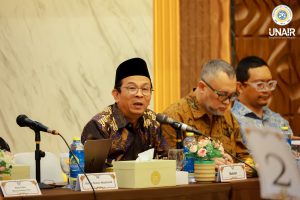
Regent of Blitar Regency Drs. H. Rijanto, MM, opened the event marked by beating the gong three times. The faculty members of FKH UNAIR also attended the opening ceremony with other guests.
There was an attachment of event caps as sign of participation. In Sasana Adhi Praja Pavilion, the procession was followed by the performance of local “Angkrok” dance.
Themed ” Together, Increase the Productivity and Quality of Animal Health for Better Blitar “, the international scope activity was followed by four delegations from South Korea. They consisted of Kangwon University, Konkuk University, and Chungnam University. There were also 6 national delegations from the University of West Nusa Tenggara, 6 participants from PSDKU UNAIR Banyuwangi, and 274 participants from FKH UNAIR.
“Every year, the community service is done in a different place. However, the concept remains the same. There is little difference this year, the existence of routine vaccinations at the community service site, especially in Srengat District by the animal husbandry agency. There are reports and evaluation of simultaneous activities by each participant from each sub-district, “said Devi.
The series of activities included briefing for field practice, free animal health checks, and presentation on the results of the activities. In preparation for the activity, Devi admitted that there were some obstacles.
“However, I think it is reasonable. And it was not a reason for us not to run the program, ” she said. (*)
Author: Pradita Desyanti
Editor: Feri Fenoria Rifa’i