
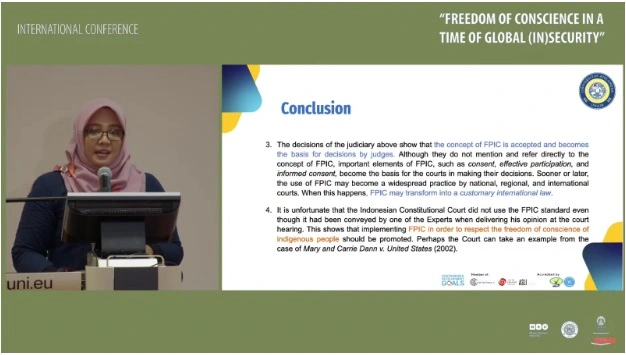
(30/4/2023) | “Freedom of Conscience in the Free Prior Consent Principle: The Approach by Indonesian Constitutional Court” is a research topic presented by Iman Prihandono, S.H., M.H., LL.M., Ph.D., and Ekawestri Prajwalita Widiati, S.H., LL. M. at the “International Conference: “Freedom of Conscience in A Time of Global (In)security” last Thursday (27/3/2023). Apart from Dr. Iman and Ekawestri, there was also a presentation from Joeni Arianto Kurniawan, S.H., M.A., Ph.D. This seminar was held by Mykolas Romeris University, a well-known university from Lithuania, in collaboration with FH UI and FH UNAIR on Thursday (27/4/2023).
In his presentation, Dr. Iman explained the background that became the basis of his research, namely Laws that Discuss Minerals and Coal and Laws that Discuss Forests. This is related to the topic he presented, namely Freedom of Conscience in the Principle of Free Prior Consent, which companies widely practice in exploiting natural resources. This concept is also often referred to as Free Prior and Informed Consent or often referred to as FPIC.
FPIC has strong roots because, in a court decision, the existence of FPIC must meet conditions such as Consultations must be held at the beginning, the principles of good faith and the aim of reaching a consensus, proper and easily accessible consultations, the existence of an AMDAL, and consultations that must be notified in advance. Therefore, FPIC is not a “playing game” concept.
In recent years, there have been many conflicts regarding land use between investors and indigenous people. This is where freedom of conscience is again called into question, which allows indigenous people to carry out all activities under the values they profess. With FPIC, this concept can prevent things like loss of freedom of conscience from happening to indigenous people whose land will be used by certain parties. Ekawestri explains this fact.
The Indonesian constitution has no parameters similar to FPIC, and Indonesia has yet to adopt FPIC in its laws. Therefore, Dr. Iman and Ekawestri conveyed in the conclusion section if Indonesia needed the adoption of concepts like this so that there would be no more violations of the freedom of conscience.