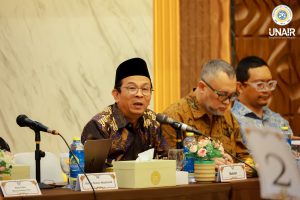


UNAIR NEWS – “UNAIR is people’s university, UNAIR is people’s university , UNAIR is people’s university,” that is what shouted by more than 300 people from Lakardowo village, Jetis, Mojokerto welcomed by UNAIR Rector while sitting on the floor of Management Office Building. Their coming was to request UNAIR’s assistance in dealing with Dangerous and Toxic Waste (B3) case which pollutes their wells.
“Five years ago, PT Putra Restu Ibu Abadi buried their waste in the community ground, while in East Java there are no companies which have permits for waste burial,” said Prigi Arisandi, UNAIR alumnus who focused on environmental preservation.
Prigi also added that they locals have done everything they could to report this to the Ministry of Environment and Forestry (KLKH), Environmental Agency (BLH) of the province and regency, but there is still no response.
“The people reported but they were accused to make things up, and when the expert team came and checked, they said there was nothing, when at least 200 kids in five hamlets had affected, and the inhabitants have to buy clean water gallons,” said the environmental activist.
They continued their protest to Grahadi Palace, on Thursday June 2. After that they moved to UNAIR requesting assistance from the academicians to handle the problems.
“We are sure that UNAIR Rector will side the people and defend us, as all this time no one defended us,” he said.
One of the locals also had an opportunity to share his piece. Supriyadi, inhabitant of Kedungpalang said that at first, the locals did not know anything about B3. But gradually, after five years, they were affected and after few protests, there are no responses at all from the authority.
“I’m worried about our children that in the next five years they will have difficult times to get clean well water, we are tired and tired, the authorities did not respond at all,” he complained.

Responding to Prigi and Supriyadi elaboration and complaint, UNAIR Rector Prof. Dr. Moh. Nasih, SE., MT., Ak., CMA., explained that the authorities have different roles. Pro. Nasih emphasized that in the near future, UNAIR will form and send a team to study the problem and analyze the case.
“Academically, we will send our team, we also have environmental, public health, social and political experts. I hope all of them can study the case in the near future,” said Prof. Nasih.
The FEB UNAIR professor also said that the results of the study will be reported to the related authorities.
“We will report the results to the rightful authorities, it’s impossible for UNAIR to close the factory as UNAIR does not have authority for that, there are other institutions for that,” he said followed with applause. (*)
Author: Nuri Hermawan
Editor: Dilan Salsabila