

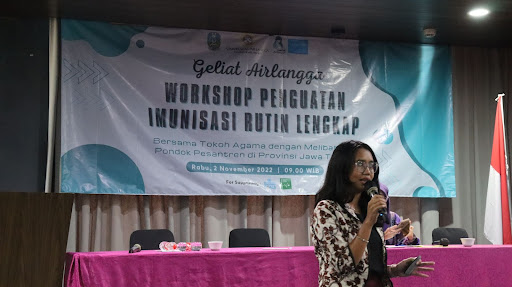
UNAIR NEWS – UNICEF highlighted the importance of communication between health human resources (SDMK) and the community. The statement was made by Emeralda Aisha, Communication for Development (C4D) officer of UNICEF, during the double immunization communication strategy dissemination held by GELIAT Universitas Airlangga and UNICEF at the Ibis Style Hotel, Surabaya, on Wednesday, November 2, 2022.
Aisha believed the community would be overwhelmed upon hearing such a long explanation. However, the lack of dissemination discourages them from conducting double immunization.
Some parents are good with short, understandable explanations, but we must be careful not to sound offensive.
“It depends on the parents,” she said.
The health workers must be aware of the parent’s concerns about their children getting double immunization. Aisha believed that neglecting their concern and saying it would be fine is not right.
Instead, it is necessary to give them an understanding of children’s protection from diseases simultaneously, such as getting measles and Penta immunization in one visit is necessary.
“However, though the parents are afraid, worried, or think that the children will be in pain, they understand that the double immunization is safe,” she said.
Apart from good communication, the health workers need moral support from all elements, such as the regent, fellow health workers, students, cadres, religious leaders, and public testimonials.
The governor’s support, by attending the dissemination or launching endorsement, is necessary, and so is inviting the press for media coverage.
“The more people see the issue, the more they know it’s not a new thing. It’s just a regular program, and it’s safe,” Aisha said.
While fellow health workers’ support could be in the form of preparedness to serve anywhere. She named another example where the security personnel welcome the patients. As the first person patients meet, they should be well-informed to respond to the patient’s needs.
“The security personnel has nothing to do with health workers. But, when the patient’s first impression when going to the Puskesmas wasn’t as they expected, they become worried, ‘how did he not know that?’” she said.
Author: Muhammad Mu’afa Rahman
Editor: Feri Fenoria