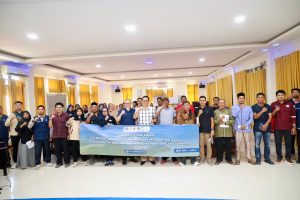


UNAIR NEWS – The Ministry of Foreign Affairs with the Department of International Law held a discussion related to the issue on law of the sea in the event titled “Legal and Security Study on the Regime of Indonesian Islands Archipelagic Seaweed (ALKI)” on Tuesday, July 25.
The event held in the Pancasila Hall in Building A Faculty of Law UNAIR was attended by Bebeb Akn Djundjunan as the Director of Legal and Territorial Treaties of Ministry of Foreign Affairs. Bebeb gave a keynote speech. In his presentation, Bebeb said that since the acceptance of the Juanda Declaration in the marine law convention about the acceptance on the concept of an archipelagic country, the interests of Indonesia has been accommodated.
“With the ALKI security for it can be focused,” he said.
The event then continued with the presentation of session I material from three speakers, Prof. Dr. Hesjim Djalal as a marine law expert who explained the history of the setting and governing of Indonesian archipelagic sea lanes in UNCLOS 1982.
Then followed by Andi Arsana, Ph.D., from Gadjah Mada University on the difference between archipelagic sea lanes and other cross-regimes. The presentation of the first session was closed by Achmad Gusman Siswandi, PhD from FH Padjajaran University who explained about the aspects of law enforcement of Indonesian archipelagic sea lanes.
On session II there were three other speakers. First, Dr. Enny Narwati from FH UNAIR who reviewed the safety of Indonesian archipelagic sea lanes in the perspective of international law. Secondly, there was Kresno Buntoro, PhD from TNI AL legal division who explained some things like the need for Indonesia to set the sea lanes in the eastern and western archipelago. Third, Dr. Iur Damos Dumali Agusman secretary of the General Directorate of HPI, the Ministry of Foreign Affairs, who discussed about the consequences of determining the archipelagic sea lanes of Indonesia related to law enforcement in Indonesian waters.
The conclusion of the event was that the balance of rights and obligations of coastal and trans-country recipient countries can not be discussed simultaneously, the focus of discussion was that Indonesia has implemented its obligations and the implementation of ALKI was not conducive because some countries reflected their military strength when they were violating the ALKI.
Moreover, the participants do the evaluation after the discussion has been completed.
Author: Pradita Desyanti
Editor: Nuri Hermawan