

UNAIR NEWS – Indonesia has great potential in the seaweed industry. As of today, from 50 species of seaweed recorded in this archipelagic country, only five species have been utilized.
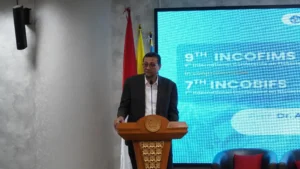
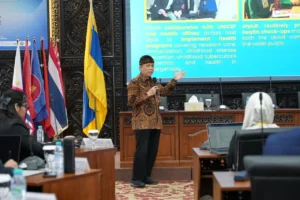
It was stated by the professor of Faculty of Fisheries and Marine Universitas Airlangga Prof. Ir. Mochammad Amin Alamsjah, Ph.D, Tuesday, August 1. He explained in The 1st International Conference Postgraduate School UNAIR Surabaya (ICPSUAS) entitled “Implementation of Climate Change Agreement to Meet Sustainable Development Goals” in Management Office Building UNAIR Campus C.
Prof. Amin stated that countries in Europe have used sophisticated technology to process the seaweed as food and cosmetic products. Seaweed has had high economic value, it could be hundred times more valuable than the material.
However, our seaweed processing has not been done as well as it should be. The seaweed processing region was located in East Java, West Nusa Tenggara, South Sulawesi and North Sulawesi.
“Indonesia at the moment still supplies raw material and only a little which produces products (gelatin). The seaweed production cannot be industrialized independently such as food and pharmacy,” stated Prof. Amin.
The five seaweed species currently produced are Eucheuma, Gracillaria, Sargassum, Gelidium, and Hypnea. All of them are produced with bottom method (seed is dispersed at the bottom of brackish water ponds), off-bottom method (seed is tied on plastic rope), floating rack method (seed is tied on plastic rope then the rope is connected to a bamboo raft), and long line method (seed is tied on plastic rope then the rope is connected to the main rope, done in deep water).
Prof. Amin expected the seaweed production to have high value in line with green economy principle. Seaweed is low emission resource, renewable and able to improve the social economy of the community.
Profesor Dr. Aini Ideris from Universitas Putra Malaysia explained about the food security. Prof. Ideris elaborated about food consumption in the country side of Malaysia. She believed that the great number of chickens determines the food security in rural area.
However, the poultry also vulnerable to diseases. One of them is Newcastle disease and the local government controls the disease by developing mass vaccination.
The Director of Postgraduate School Universitas Airlangga Prof. Dr. Sri Iswati, S.E., M.Si., Ak said that the conference held on August 1-2, 2017 will be a scientific forum where the academics from any disciplines presenting almost 200 scientific papers on climate change.
Climate Change is the theme because of its urgency faced by people around the world. According to Prof. Iswati, the academic community has moral responsibility to contribute solutions regarding the environment.
“We all feel the impact of climate change. These changes should be reduced so our environment preserved well for all our descendants. Climate change must be reduced academically,” stated the Director of Postgraduate School.
In the panel discussion, there will be eleven papers to be presented. Some of them are “Decent Work and Economic Growth”, “Climate Change and Zero Hunger”, “Zero Poverty”, and “Good Health and Well-being”.
Prof. Iswati added that the papers to be presented in the conference will be published in a proceedings indexed by ICE Thomson Reuters.
Author : Defrina Sukma S.
Editor : Binti Q. Masruroh