
Faculty of Law Universitas Airlangga (FH UNAIR) sent a delegation to take part in the International Colloquium at the Law Faculty of Universiti Teknologi MARA (UiTM) Shah Alam, Malaysia on Monday (17/10/2022). The conference with the theme “Strengthening the Role of Law to Foster the Use of Technology and Innovation for Sustainable Development” was attended by academics and researchers from FH UNAIR and FH UiTM.
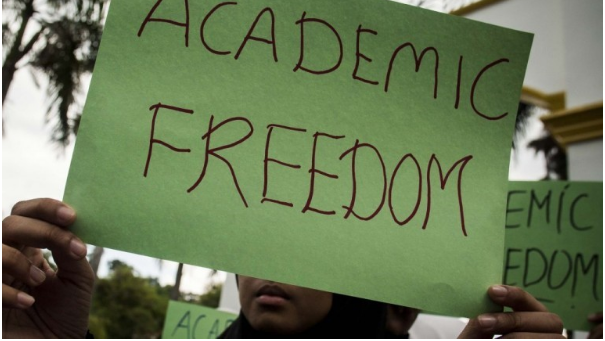
One of the researchers from FH UNAIR is a 2019 FH UNAIR student, Pradnya Wicaksana. Pradnya presented his paper entitled “Academic Freedom and Democratic Regression in Indonesia: What Law Can Do” which examines academic freedom and the decline of democracy in Indonesia from a legal perspective. Academic freedom is regulated in Article 34 of the International Covenant on Civil and Political Rights (ICCPR) and Article 13 and 25 of the International Covenant on Economic, Social and Cultural Rights (ICESCR).
Pradnya chose to research academic freedom and the decline of democracy in Indonesia because the existing laws and policies in Indonesia are not supported by quality research. In addition, the fall of democracy in Indonesia occurs because the policymakers put science aside in an authoritarian way. Even though the ICCPR and ICESCR have regulated it, academic freedom is still not fully protected or has minimal protection due to the inability of academic institutions to support existing knowledge.
Pradnya also said that academic freedom has indeed been recognized in the provisions of Article 8 paragraph (3) and Article 9 of Law Number 12 of 2012. However, academic freedom is not categorized as a human right. In fact, according to the 2017 Surabaya Principles, public authorities should respect, protect, and guarantee academic freedom as part of human rights. In addition, Ministerial Regulation Number 35 of 2017 also regulates the legal relationship between higher education institutions and public authorities in the application of protection of academic freedom. In conclusion, Pradnya emphasized that the existing law should protect academic freedom and democracy so that it does not experience a setback as it is today.