

UNAIR NEWS – Taking students to field trip makes them gain more insights. Beside knowing the real condition, theories learned in classes can be understood better. It was what Dr. Sri Wiryanti Budi Utami, M.Si. a lecturer of Indonesian Literature Department UNAIR when she took her students to field study (PKL) to Samin tribe.
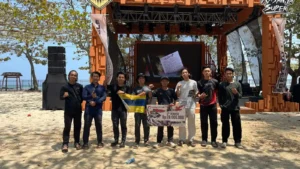
In the Samin tribe community, in Jepang, Margomulyo Village, Bojonegoro, the lecturer who handles Discourse Analysis took her students to explore the locals in Samin tribe in Bojonegoro on Saturday, December 3 and Sunday December 4.
“There have been foreign visitors coming here in Holland, Japan, and Africa too. Therefore as Indonesian you have to understand more the Samin discourse,” explained Wiryanti in her opening address. “We are coming to the living source of the history, so use this opportunity well,” she said.
Accepted in the house of Harjo Kardi as the fourth descendants of Samin Surosentiko (the founder of Saminism), there were 120 students watching film on Samin tribe. Furthermore, Harjo Kardi, better known as mbah Harjo provide backgrounds on Samin teachings.
“It has become my obligations. A lot of people came here and asked about Saminism. What need to be emphasized is Samin is not a tradition, not a religion but behaviors,” he said. “If after the film there are still some things you do not understand, please go ahead and ask me,” he added.
Samin tribe has spread in some areas around the border of Central Java and East Java, which covers Blora, Ngawi, Bojonegoro and also Pati. Mbah Harjo also explained that actually Samin is a way of life applied by his ancestors during Dutch colonialism. But when Indonesia achieved its independence, the values are carried on.
“Samin means similarity, our ancestors were the same, they were Javanese, they were colonized, and so they were fighting together through harmless ways,” he said.
In the field study, students were tasked to explore various discourses in Samin tribe, from politics, language, demography, to social interaction. Wiryanti also challenged them to make a play about Samin people.
“If there are students who want to make the play, we will support. So they will know the philosophy and story. Hopefully this field study can give them insight and knowledge as literature students who study language and culture,” she said. (*)
Author: Nuri Hermawan
Editor: Dilan Salsabila