


Imagine you are driving a car on a smooth highway, when suddenly the brakes fail. The more you press the accelerator, the more the car swerves toward the edge of a cliff. That is a fitting picture of our nation’s condition today. Government programs and policies designed to promote public welfare often end up going in the wrong direction. This is not because of a lack of funds or brilliant ideas, but because of the “inflation of conscience” among officials. Like price inflation, this moral inflation grows bigger day by day, while the value of conscience shrinks dramatically. As a result, oversight of national programs becomes weak, and ordinary people become the victims.kpk+1
What does moral inflation mean? Simply put, it is a condition in which empathy, integrity, and responsibility among officials become thinner and thinner. Those who should be steering the nation end up busy filling their own pockets. Data from the Corruption Eradication Commission (KPK) show that during 2025 alone, there were hundreds of corruption cases involving high-ranking officials, with state losses reaching trillions of rupiah. This is not merely a number, but clear evidence that their conscience has become severely “inflated.” Programs such as social assistance, infrastructure, and fertilizer subsidies, which should improve people’s lives, are instead diverted along the way.
Let us trace the roots of the problem. First, there is a recruitment system for officials that prioritizes connections over competence. Many rise to power not because of a track record of serving the public, but because of political backing or party “envelopes.” The result is officials whose conscience is already contaminated by personal ambition. Second, impunity has become widespread. Punishments for corruptors are often light, almost as if they are being rewarded rather than punished. This makes their conscience even weaker, because they feel safe when acting dishonestly.
Take the food estate program, for example, which was promoted as a solution for food security. At first, the promise sounded beautiful: vast agricultural land would create food self-sufficiency and prosper farmers. But what actually happened? Audit reports from the Audit Board of Indonesia (BPK) pointed to significant irregularities, damaged land, and local farmers losing access to cultivate their own fields. The inflated conscience of the overseeing officials turned the program into a monster that ended up harming the people. Farmers in Kalimantan or Papua, who should have benefited, were left with nothing but empty promises while their land was taken over by corporations.
Then there is social assistance, which has also become a magnet for corruption. During the pandemic, aid funds intended for the poor were misused for the private enjoyment of officials. Cases in several regions showed fictitious beneficiaries, aid cards being sold, and money flowing into personal accounts. The result was heartbreaking: the people who truly needed help were left hungry. Moral inflation is not only about money; it is also about the loss of shame. Officials who should feel sorrow when seeing village children unable to attend school because of cost instead enjoy luxury vacations abroad.
Moral inflation also spreads into infrastructure policy. Highway and dam projects, which look magnificent on paper, often become fields of corruption. Bribery cases in the Ministry of Public Works and Housing in previous years showed that project prices were marked up by around 30 percent. Public money that should have been used to build good bridges vanished into the pockets of contractors and officials. The result? Roads crack before their time, floods remain unsolved, and people in remote villages stay isolated. It is like a doctor who ends up poisoning the patient.
Why is this inflation becoming so uncontrollable? One of the triggers is a lavish lifestyle that has become the standard among officials. Social media is full of photos of birthday parties with two-meter cakes, rows of luxury cars, or holidays in Europe. Meanwhile, people on the city outskirts struggle with rising rice prices. A healthy conscience would be shocked by this contrast, but an already inflated one simply does not care. Social psychologists call this “moral desensitization”: the more often one sees poverty, it feels more and more like dying.
The impact on public welfare is enormous. Poverty remains stuck above 9 percent, youth unemployment reaches 15 percent, and the gap between rich and poor keeps widening. Programs such as the Pre-Employment Card and National Health Insurance, which have great potential, often fail to deliver because supervision is weak. Officials are busy meeting in five-star hotels while field implementers freely commit corruption. In the end, the people who were promised prosperity suffer even more.
But we should not give up. There is a way out of this moral deflation. First, reform the appointment system for officials by applying strict integrity tests, as Singapore does through its Corrupt Practices Investigation Bureau. There, candidates must disclose assets transparently and remain under long-term scrutiny. We can adopt a similar model, with a more independent KPK.
Second, impose firm and uncompromising sanctions. Severe punishment for large-scale corruption, as seen in China, can serve as a deterrent. More importantly, court verdicts should be widely publicized so that the conscience of other officials shrinks in fear. Third, involve the public in oversight. Digital corruption-reporting platforms, such as an improved Lapor.go.id, can become powerful tools. People can become the nation’s eyes and ears.
Fourth, nurture conscience from an early age. Schools and universities must instill anti-corruption values, not just formula memorization. For example, mandatory village internships for future leaders could help them feel the bitterness of poverty. Fifth, the role of the media and civil society is crucial. Critical public opinion can “deflate” moral inflation, as seen in recent public movements that strongly monitored judicial decisions.
The government must also set an example through a simple lifestyle. If the president and ministers voluntarily cut their salaries for social assistance instead of showing off luxury abroad, that would send a powerful message. Imagine if officials collectively rejected bribes and chose modest living—their conscience would naturally deflate back to health.
Brothers and sisters, the moral inflation of officials is not a fate we must simply accept. It is a crisis that can be overcome with strong political will and collective public effort. National programs and policies will return to the right track if officials’ conscience is “deflated” by integrity. Let us begin with ourselves: reject small bribes, report misconduct, and choose leaders with conscience. A prosperous nation is not a dream, but a shared responsibility. The time has come for officials to realize: office is not for getting rich, but for serving the people!
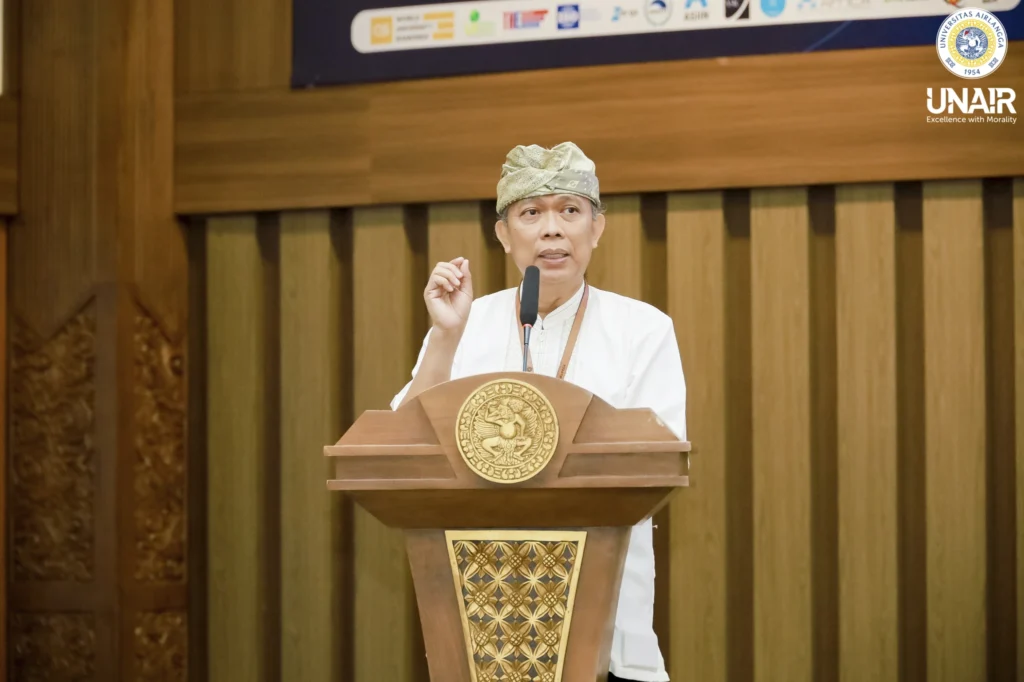
Writer: Hery Purnobasuki (Professor Faculty of Science and Technology, Universitas Airlangga; Chairman Sustainable Community Service Institute, Universitas Airlangga)