

UNAIR NEWS – The government must refer to Article 33 of 1945 Constitution in managing and optimizing natural resources so they are useful for the people. Even though the government has established state owned companies either national or regional ones, it still needs to make refulation which prioritizes national interests, including accommodating private party interests.
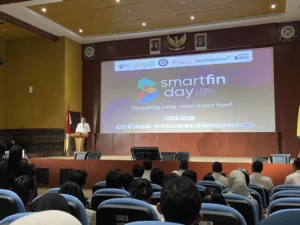
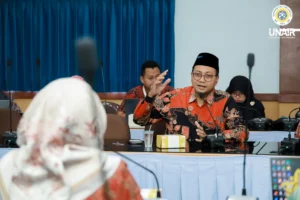
The statement was stated by Faizal Kurniawan, S.H., M.H., LL.M, a lecturer and researcher of Civil Law Department Universitas Airlangga (UNAIR). The research was presented in a parallel discussion “Symposium I: University Network for Indonesia Infrastructure Development” in Graha Institut Teknologi 10 Nopember.
The topic of government and private party cooperation in infrastructure development from this regulation aspect is the research protection. In the discussion, at least three topics were presented by Faizal and FH UNAIR team.
The three titles were “Creating Role Models on Sustainable Financing in The Public Private Partnership (PPP) in Infrastructure Projects”; “Elaborating Appropriate Models of the Sustainable Financing Instruments in Public Private Partnerships (PPP); “National Interests as the Legal Foundation in Encouraging Public Private Partnerships in Indonesia”.
According to Faizal, to accelerate infrastructure in Indonesia, the government have to make regulations needed. They must not conflict with the national interests.
“The indicator is the government makes regulations which do not contradict with the public law and order. There is an elaboration of Article 33 of 1945 Constitutions that earth, water and natural wealth in them must be raw materials and owned by the government. To achieve national interest, the leading sector is the government,” said Faizal.
There are two cases used in Faizal and his team’s research. First, superior projects and second, energy saving initiation. In a superior project problem, Faizal said that theremust be correct mechanism in the PPP scheme.
“Are the project using PPP mechanism, regional cooperation, or central government with the regional one. The overlapping regulations often happen in Indonesia. Does the government does the PPP obey to the regional cooperation regulation or tp the government-private party cooperation,” said Faizal.
To guarantee the acceleration of infrastructure development, last year, President Joko Widodo issued a Presidential Decree Number 4 of 2016 on Electricity Insfrastructure Development Acceleration (PIK). According to the lecturer of Civil Law Department, the decree is not strong enough to protect the infrastructure development acceleration legally.
“If the law of commerce is still higher in position so it could rescind the agreement made, and the instruction of President was still in form of presidential decree, they don’t match,” said Faizal.
Therefore, the regulation made must reflect the good principles of law, such as showing clear objectives, suitability of regulation and values, and clear backgrounds.
Beside being overlapping, the new regulations must also accommodate initiatives from the private parties. According to Faizal, the concepts offered by private parties on infrastructure especially on electricity are more innovative.
“There are private parties who have concepts on electricity efficiency. So, which regulation can be use for them, Presidential Decree 38 on government-private party cooperation, or sectoral law on energy. As it is a new idea and there aren’t any regulation which facilitates it, on the other hand the government is confused too,” he added. (*)
Author: Defrina Sukma S.
Editor: Nuri Hermawan