
Technological developments cannot be denied in this era. Technological developments have both positive and negative impacts. One form of this technological development is the presence of ChatGPT, an application developed with the Large Language Model (LLM).
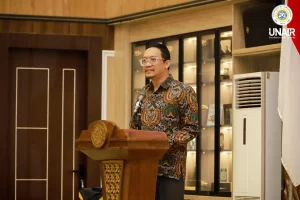
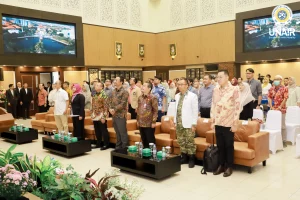
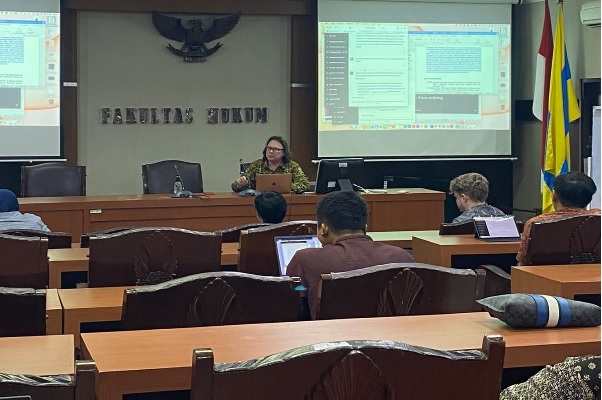
Faculty of Law, Universitas Airlangga held a discussion between lecturers and students on Wednesday (10/4/2023) at R. Gondowardoyo Building A FH UNAIR, with Prof. Stefan Koos of the University of the Bundeswehr Munich Germany. Prof. Stefan Koos conveyed the various benefits of ChatGPT from a legal perspective, starting from the legality and what legal consequences will be obtained from the ChatGPT.
“In its development, there are still many shortcomings which will later be used as an evaluation in developing ChatGPT properly, considering that ChatGPT is a development of Artificial Intelligence (AI) which has not been specifically regulated, especially in Indonesia,” said Prof. Stefan Koos.
Prof. Stefan Koos also conveyed that, conceptually, products from AI are subject to the users or creators of AI itself, which are regulated by copyright. Indonesia controls copyright as stated in Law Number 28 of 2014 concerning Copyright. AI, so far in its application, cannot be used as a source of what is asked of humans against AI, bearing in mind that AI in its legality, still needs to be covered by legal protection, especially in Indonesia. Meanwhile, regarding the electronic system in Law No. 11 of 2008, jo. Law No. 19 of 2016 concerning Information and Electronic Transactions (ITE) has not been able to accommodate the presence of AI.
The attribution of AI-assisted products to humans as programmers is divided into three. Namely AI is a tool created by humans that is categorized as copyright; design decisions are formed by AI or autonomous, which are classified as non-copyrighted. Finally, design decisions by humans and AI are indexed depending on their position and attribution to humans.
“The workings of ChatGPT which are used in writing are divided into several stages, starting from writing an introduction or general overview, summarizing the text, correcting the text, modifying sentence formulation, translating, to structuring the preparation of the text,” said Prof. Stefan Koos.
Prof. Stefan Koos hopes that with the development of technology, humans will be more helpful. However, legal regulation must also keep up with the times to create legal certainty and protection for the community.