

UNAIR NEWS – The use of tear gas by the police in the Kanjuruhan Tragedy has drawn public criticism. The misused tear gas was assumed to be the main cause of 132 deaths in the stampede.
The assumption was proven by the investigation result of the Joint Independent Fact Finding Team (TGIPF) of the Kanjuruhan Tragedy under the Coordinating Minister for Political, Legal, and Security Affairs, Mahfud MD. TGIPF concluded that the tear gas was indeed the main cause of the deadly stampede with massive victims’ deaths.
Responding to the investigation result, Universitas Airlangga toxicologist, Shoim Hidayat dr MS, shared his professional view. The tear gas was made of chemical compounds, like chlorobenzylidenemalononitrile (CS), diphenylaminechlororarsine (DM), dibenzoxazepine (CR), chloroacetophenone (CN), and pepper spray or Oleoresin capsicum. Of these materials, chlorobenzylidene malononitrile (CS) was the most widely used and produced by PT Pindad.
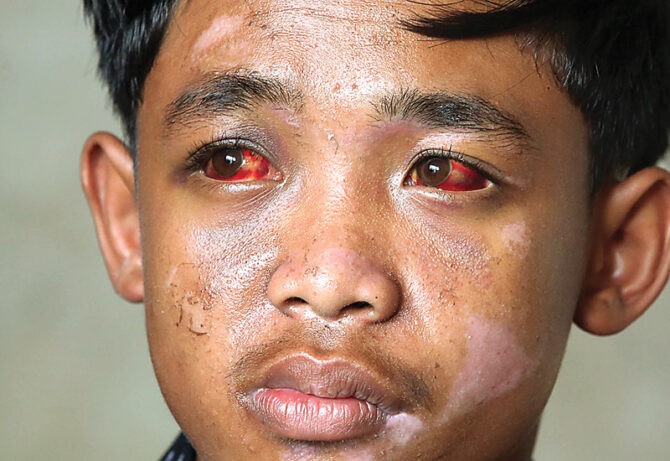
The chemical compounds in the tear gas are all strong irritants. It stimulates mucous membranes in human organs, such as the sclera (white of the eye), respiratory tract, and digestive tract. These organs are the most vulnerable to the effect of tear gas.
Depends on the content and duration of exposure
The Faculty of Public Health (FKM) lecturer said that the severity level depends on two conditions: tear gas content and exposure duration.
“Take a closer look at the Kanjuruhan Tragedy. Seeing the number [of released tear gas] is enough to measure the high concentration, especially in a closed space. People in the middle of the field might be okay, while the ones in the stands were at higher risks in such a closed area,” he said.

Shoim further stated that the longer the tear gas exposure, the more severe the impact. Combining those two, the severity levels will increase, causing complications.
“If [the content] is low and quick exposure, the effect will occur for twenty seconds and disappear in 30 minutes to an hour. In severe cases, it will cause complications, leading to death. If you’re exposed to the tear gas for a moment, it takes 30 minutes to recover. Because the purpose of tear gas is to prevent the crowds from flocking,” he said.
Causing inflammation
Shoim explained that the irritated mucosa causes inflammation at light or severe levels. If the victim suffers from severe inflammation, it takes a long time to heal and may lead to disability. For instance, if the cornea is exposed, it will cause eye disorders or blindness.
If severe inflammation occurs in the respiratory tract, it causes swelling that makes it hard to breathe due to the narrowing airways. Even worse, if the narrowing of the respiratory tract is followed by pain, severe acute respiratory syndrome may occur. It may lead to breathing difficulty and also death.
If severe inflammation occurs in the respiratory tract, it causes swelling that makes it hard to breathe due to the narrowing airways. Even worse, if the narrowing of the respiratory tract is followed by pain, severe acute respiratory syndrome may occur. It may lead to breathing difficulty and also death.
Author: Rafli Noer Khairam
Editor: Binti Q. Masruroh