

UNAIR NEWS – The creativity of UNAIR students always makes positive achievements. This time, five students in a team of Invention Student Creativity Program (PKM-KC) has successfully developed AUROWS robot (Automation Robotic Waste Transporter & Sterilizer): Bacterial Sterilizer and Clinical Waste Transporter Robot to reduce the nosocomial infection in hospital.
The five students of Faculty of Vocational Studies are Akhmad Afrizal Rizqi (head of the team), Agus Abdul Rozaq, Rafif Nadhif Naufal, Abdul Hamid, and Inas Pramitha Abdini Haq. The innovation proposal supervised by Fadli Ama, ST., MT ini, qualified in 2016 PKM and received development fund Rp 12,200,000.
In was called as a smart robot as it can take, move and sterilize the hospital waste bin. The robot was given ability to move automatically, with a sensor connected to computer, so it eases the users or medical staff to monitor the robot and to kill the bacteria with LED ultraviolet.
”It improves the germisidal irradation effect which kills bacteria completely with 365 nm wavelength and input power 15 mW,” said Akhmad Afrizal R.
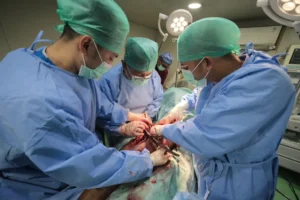
The reason behind AUROWS was the nosocomial infection which causes 1.4 million death every day at global level. Nosocomial infection is the infection acquired and developed in hospital. The infection is caused by pathogenic bacteria in the clinical waste in hospital.

In Indonesia, the mortality rate is high, it reaches 12 – 52 %. This infection causes various diseases. Some of the diseases caused by this infection are urinary tract infection, blood flow infection, pneumonia, infection of surgery wound.
”There are many things affecting this nosocomial infection distribution such as medical waste. It is now still transported with human power, so it is dangerous as they are vulnerable to nosocomial infection,” added the student of Instrumentation System Automation.
As the head of the PKM-KC AUROWS team, Akhmad hoped that the robot can be an instrument for the medical staff to transport the medical waste and sterilize the area, so it minimizes the nosocomial infection in hospital of Indonesia and actualize medical instrumentation independence. (*)
Editor : Bambang Bes.