

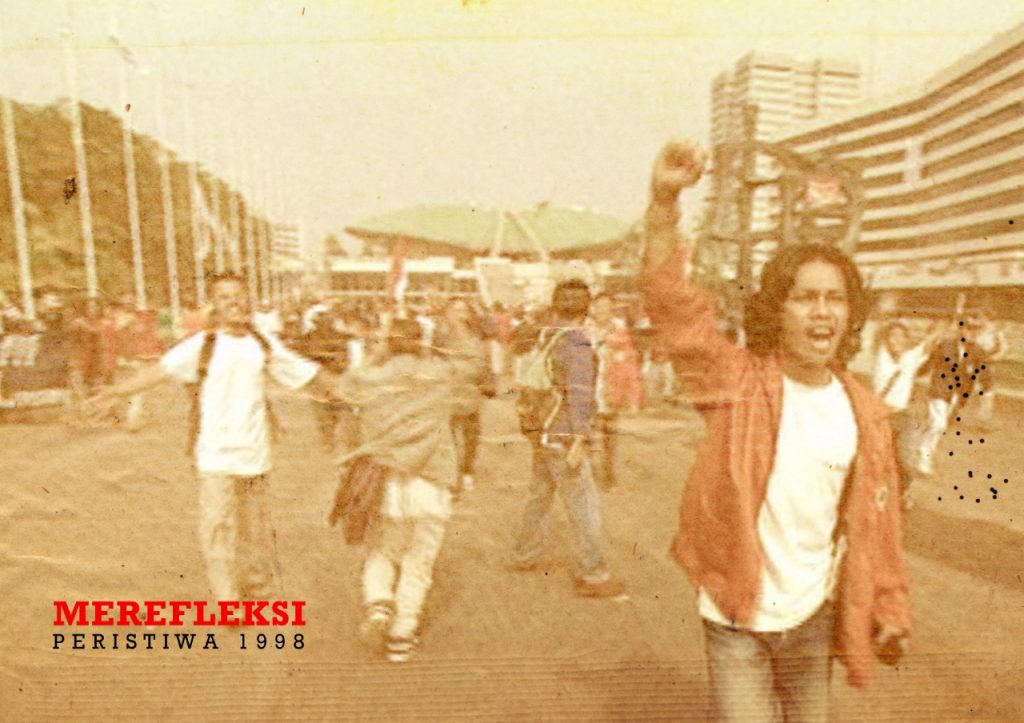
UNAIR NEWS – Political transformation and the collapse of the New Order regime marked the end of the second millennium in Indonesia. Universitas Airlangga (UNAIR) played an active and significant role in the historic 1998 Reform Movement that profoundly impacted the nation. The economic and political crises at the time triggered widespread student demonstrations across universities, including UNAIR, demanding comprehensive change.
With full support from university leadership, UNAIR students participated in demonstrations legally organized by the Student Senate and the Student Representative Council (BPM). The aspirations voiced during these demonstrations centered on improving the nation’s economic, legal, and political conditions. UNAIR Rector at the time, Prof dr Soedarto DTM&H PhD, openly expressed his support for the students and emphasized the importance of conducting peaceful demonstrations to safeguard the nation’s future.
In May 1998, the reform demands escalated further. The entire academic community became involved, and pamphlets titled Undangan Resmi Reformasi were distributed across campus. These pamphlets invited the academic community to participate in a large-scale reform assembly held on Friday, May 8, 1998, at the Central Library courtyard of UNAIR. During the assembly, the academic community collectively demanded far-reaching reforms, including the resignation of President Soeharto.
Reform solution
In addition to participating in demonstrations, Universitas Airlangga established a special task force to formulate comprehensive solutions for reform. These solutions encompassed various areas, including promoting market efficiency, eliminating economic distortions, optimizing resource allocation, and implementing Good and Clean Governance in the economic sector. In the legal sector, the proposed solutions called for the enforcement of democratic law, guaranteeing freedom of association and expression, and strengthening anti-corruption efforts. In the political sphere, the university called for an end to authoritarian governance, redistribution of political power, and enhanced public participation in policymaking processes.
These reform demands across the economic, legal, and political sectors were formally reinforced through a statement signed by Prof. RM Soejoenoes, who was the senior-most professor at UNAIR at the time. It is important to note that students did not act alone; they received full support from university leadership, faculty members, and alumni. The compiled demands were subsequently submitted to the Minister of Education and Culture in Jakarta.
Amplifying aspirations
In an effort to expand the reach of their aspirations beyond the university, a group of students under the banner of Mahasiswa Universitas Airlangga Pro-Reformasi (MUPR) conveyed their demands through a public broadcast on Radio Republik Indonesia (RRI) in Surabaya. The broadcast, which lasted for approximately 20 minutes, featured a formal reading of the students’ demands, followed by the playing of Indonesia Raya.
The students’ reform movement, however, was not without obstacles. On the afternoon of Tuesday, May 19, 1998, students marching north along Dharmawangsa Street were confronted by military personnel, resulting in violent clashes and physical assaults against the demonstrators. Finally, on Thursday, May 21, 1998, President Soeharto officially announced his resignation after 32 years in power. During this critical period in the history of Indonesia’s reform movement, Universitas Airlangga mourned the tragic loss of two students from the Faculty of Social and Political Sciences (FISIP), whose sacrifices remain a solemn reminder of the high price paid in pursuit of national change.
Source: Mendidik Bangsa, Membangun Peradaban (Sejarah Universitas Airlangga), by Prof. Dr. Sarkawi B. Husain et al.
Author: Yang Ramadia Nurya Syifa
Editor: Yulia Rohmawati