

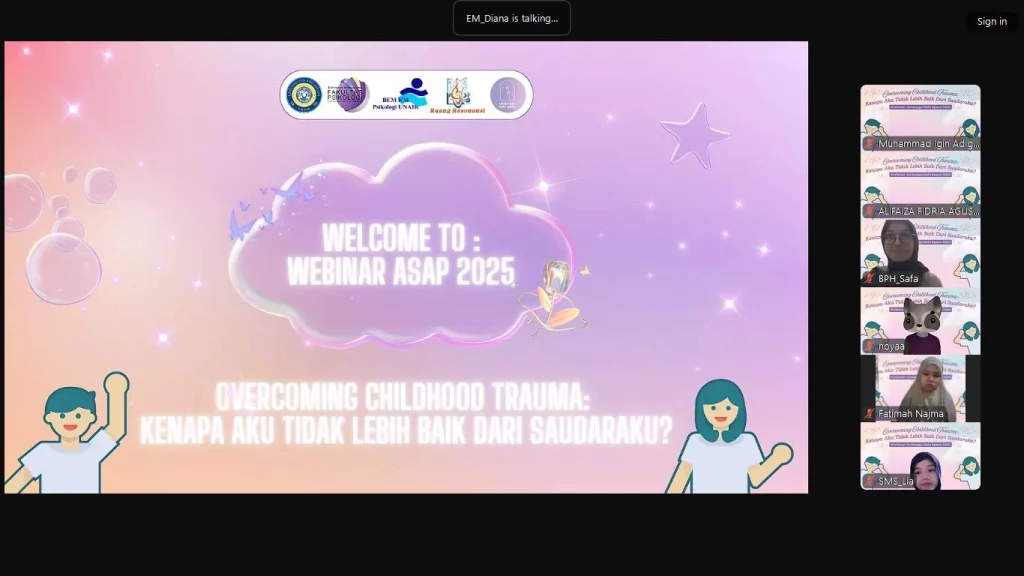
UNAIR NEWS – The Airlangga Safe Space (ASAP) community, a mental health initiative under the Branding Department of Faculty of Psychology’s Student Executive Board (BEM) of Universitas Airlangga (UNAIR), hosted a webinar titled Overcoming Childhood Trauma: Why Am I Not Better Than My Sibling? The event was held virtually on Saturday, May 24, 2025.
ASAP was founded with the aim of contributing to mental health awareness and support, particularly among the broader public. The webinar sought to address common psychological issues—especially those affecting children—that are often experienced both consciously and unconsciously.
Birth order and emotional wounds
The session focused on parenting culture and the tendency to compare children based on their birth order. The discussion referenced Alfred Adler’s birth order theory, which he developed from personal experience. Speaker Tiara Diah Sosialita, a licensed psychologist, explained that such cultural practices reinforce family expectations and roles based on a child’s position in the birth hierarchy.
“In many cultures, including Indonesia, the eldest child is often expected to uphold traditions, the middle child tends to be overlooked, and the youngest is seen as someone who needs protection. These assumptions can become deeply rooted in parenting styles and are often tied to the emotional wounds that cause childhood trauma,” Sosialita said.
She further emphasized that childhood trauma doesn’t always stem from obvious external events like abuse. Instead, it can develop from subtle, unrecognized emotional experiences. According to her, trauma is closely linked to personal emotional wounds that shape a person’s inner life.
“When emotional experiences go unnoticed by both the child and the parents, the child may begin to form negative beliefs about themselves. These unresolved wounds can create persistent internal voices that stay with them into adulthood, ultimately affecting their psychological well-being,” she added.
Healing childhood trauma
Sosialita explained that childhood trauma often shapes emotional responses, thought patterns, and interpersonal relationships. Addressing these effects requires intentional strategies to promote healing and emotional stability.
“There are several ways to address childhood trauma,” she advised. “These include healing the inner child, cultivating personal growth based on one’s strengths, seeking therapy and professional support, and—most importantly—validating and accepting oneself. That’s the key to real healing.”
Author: Ersa Awwalul Hidayah
Editor: Yulia Rohmawati