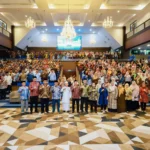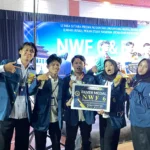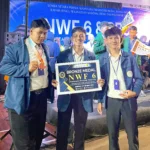
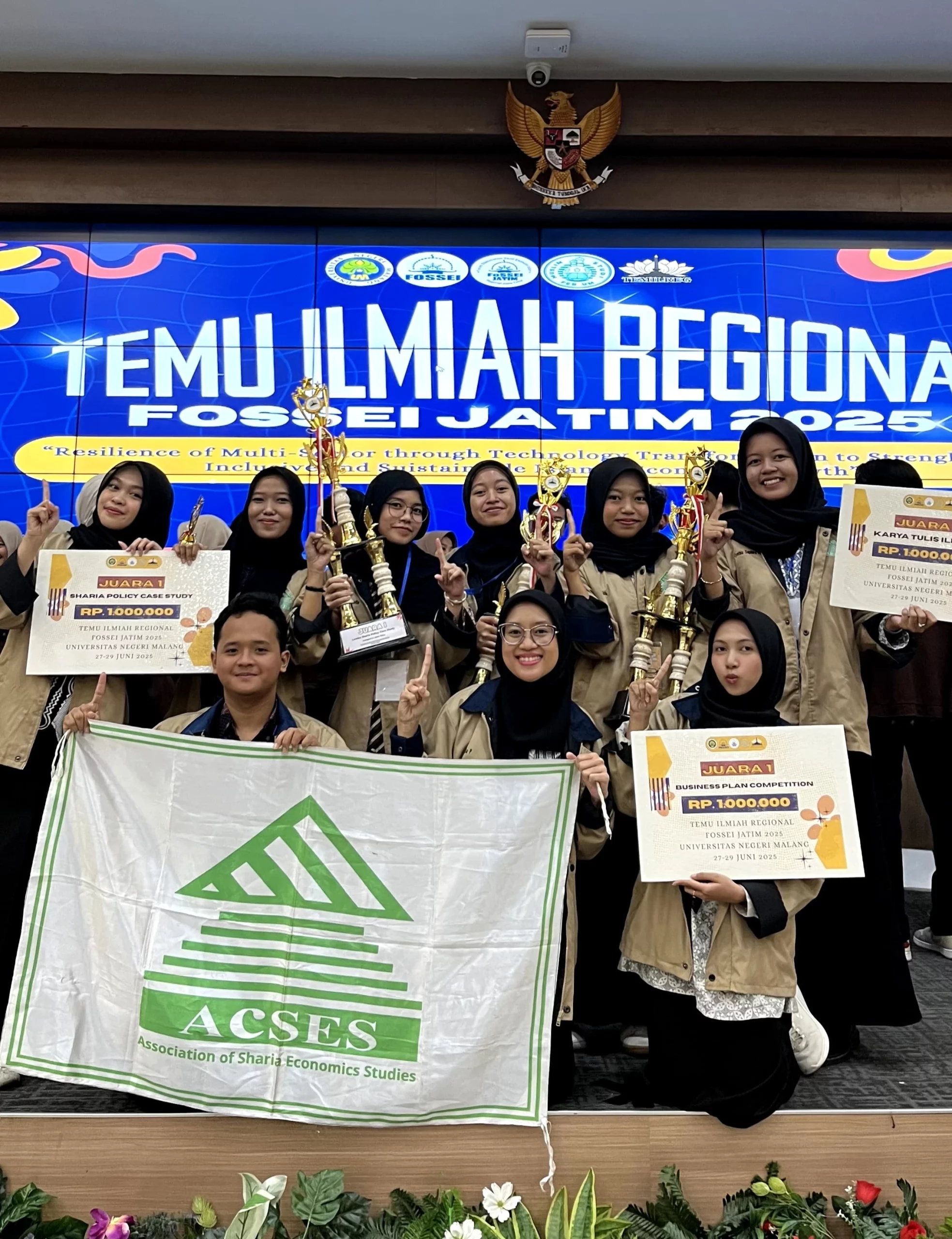
UNAIR NEWS – Students from Universitas Airlangga (UNAIR) have once again made their mark through academic excellence. Twelve students from the Islamic Economics Study Group (KSEI) AcSES at the Faculty of Economics and Business (FEB) secured top honors at the 2025 East Java Regional Scientific Forum (Temilreg). The competition, hosted by FoSSEI East Java, took place on Friday and Saturday, June 27–28, at Universitas Negeri Malang.
Representing UNAIR in three separate teams, the students clinched first-place titles in three categories: Sharia Business Plan (SBP), Scientific Paper Competition (LKTI), and Sharia Policy Case Study (SPCS). Each team was composed of students from various academic programs, including Development Economics, Islamic Economics, Accounting, and Management.
Forward-thinking, real-world solutions
In the SPCS category, the team of Dinnaya Mahashofia, Frisca Kusumawati, and Lingghia Putri Atma Negara introduced a policy concept titled the Integrated Islamic Regulatory Sandbox. Their proposal aims to merge Islamic financial supervision with fintech regulation, involving oversight bodies such as the Financial Services Authority (OJK), Bank Indonesia (BI), and the National Sharia Council (DSN-MUI). The team also developed the Automated Sharia Compliance Monitoring System (ASCMS), an AI- and blockchain-based solution.
“This innovation not only supports the rapid development of Islamic financial products,” said Mahashofia, team leader for SPCS, “but also strengthens governance, encourages the growth of halal MSMEs, and lays the foundation for a more inclusive and sustainable Islamic digital infrastructure.”
Similarly, teams competing in the LKTI and SBP categories also presented impactful solutions. Led by Muhammad Naufal Fauza, the LKTI team proposed a blockchain-based platform to help MSMEs overcome barriers such as limited access to capital and low financial literacy. Meanwhile, the SBP team, headed by Dwi Wahyulia Putri, introduced Groverra, an environmentally conscious solution that repurposes agricultural waste.
Overcoming challenges with strong support
Beyond their innovative ideas, the three teams navigated significant challenges throughout the competition. Emalia Sintawati, a member of the SBP team, noted the difficulty of juggling competition prep with academic obligations. “One of our toughest challenges was the short preparation time. The event coincided with final exams, so we had to split our focus between schoolwork and the competition,” she explained.
The success of FEB UNAIR’s teams was bolstered by the support of KSEI AcSES, which provides both intellectual and spiritual development opportunities for students. AcSES offered comprehensive assistance—ranging from proposal and paper reviews to debate mentoring and technical coaching.
“Throughout the competition, AcSES gave us valuable input on the innovations we were working on,” said Cynthia, a member of the LKTI team. “That guidance really helped us prepare more effectively.”
Author: Rosa Maharani
Editor: Yulia Rohmawati