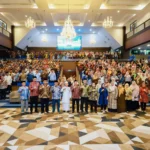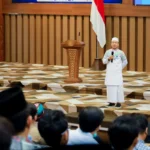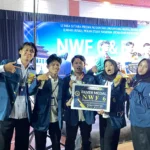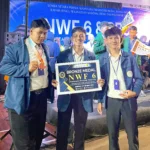
UNAIR NEWS – Three students from Universitas Airlangga’s Faculty of Economics and Business (FEB) represented their university at the prestigious 2025 Regen Asia Summit (RAS), hosted by the National University of Singapore (NUS). Held from Thursday to Saturday, June 3–6, the event welcomed more than 600 youth delegates from across Asia.
The UNAIR representatives—Ayano Matsumoto (Management 2022), Dian Budiono (Management 2023), and Zidane Yusavito (Islamic Economics 2023)—participated in a series of compelling sessions focused on the theme of Regeneration, a concept that builds on sustainability by advocating for the active restoration of ecosystems and communities.
“For me, the most powerful moment was the fireside chat with Singapore President Tharman Shanmugaratnam. Hearing his take on regeneration from a national leadership perspective was both a privilege and the highlight of the summit,” said Matsumoto.
Gaining firsthand insight into environmental leadership
Beyond the keynotes and workshops, the program also featured influential leaders in policy and environmental advocacy. Among them were Yeo Bee Yin, Member of Parliament for Puchong and former Malaysian Minister of Energy and Environment, and Jomo Kwame Sundaram, a senior advisor to the Khazanah Research Institute and former UN official.

Delegates came from leading institutions like Peking University, Seoul National University, and Tsinghua University. The summit brought together students from across East Asia, South Asia, and ASEAN countries, enriching discussions with a wide range of cultural and regional perspectives.
Throughout the event, UNAIR’s delegates actively engaged in dialogues on pressing environmental issues. Matsumoto shared that they had the chance to interact with speakers during breakout sessions.
“We discussed ESG topics, particularly green bonds, and also joined an interactive session with a food tech professor from NUS, where we explored food waste and agricultural conditions in Indonesia,” Matsumoto noted.
To attend RAS 2025, applicants had to undergo a competitive selection process, which included submitting a personal essay, résumé, and international identification such as a passport. Matsumoto’s motivation stemmed from her leadership role in RWLD, a nonprofit focused on digital environmental awareness. Her experience as a 2024 IISMA delegate at Hanyang University in South Korea also fueled her interest.
“While I was with IISMA, I discussed the environmental toll of nickel mining in Indonesia. Many participants were shocked—it raised awareness about the urgency of our environmental situation,” she added.
Embracing cultural diversity and overcoming challenges
Despite the scale of the summit and the diverse cultural backgrounds represented, the UNAIR delegation quickly adapted and engaged. “At first, the sheer size and cultural differences were intimidating. But I realized the value of this experience and made the effort to step up by initiating conversations,” Matsumoto explained.
Aside from academic sessions, participants had the opportunity to explore Singapore together—an experience that fostered cultural exchange and lasting international friendships. “This summit offered not only a chance to learn from leading experts, but also to connect with peers from across Asia,” Matsumoto concluded.
Author: Rosa Maharani
Editor: Yulia Rohmawati