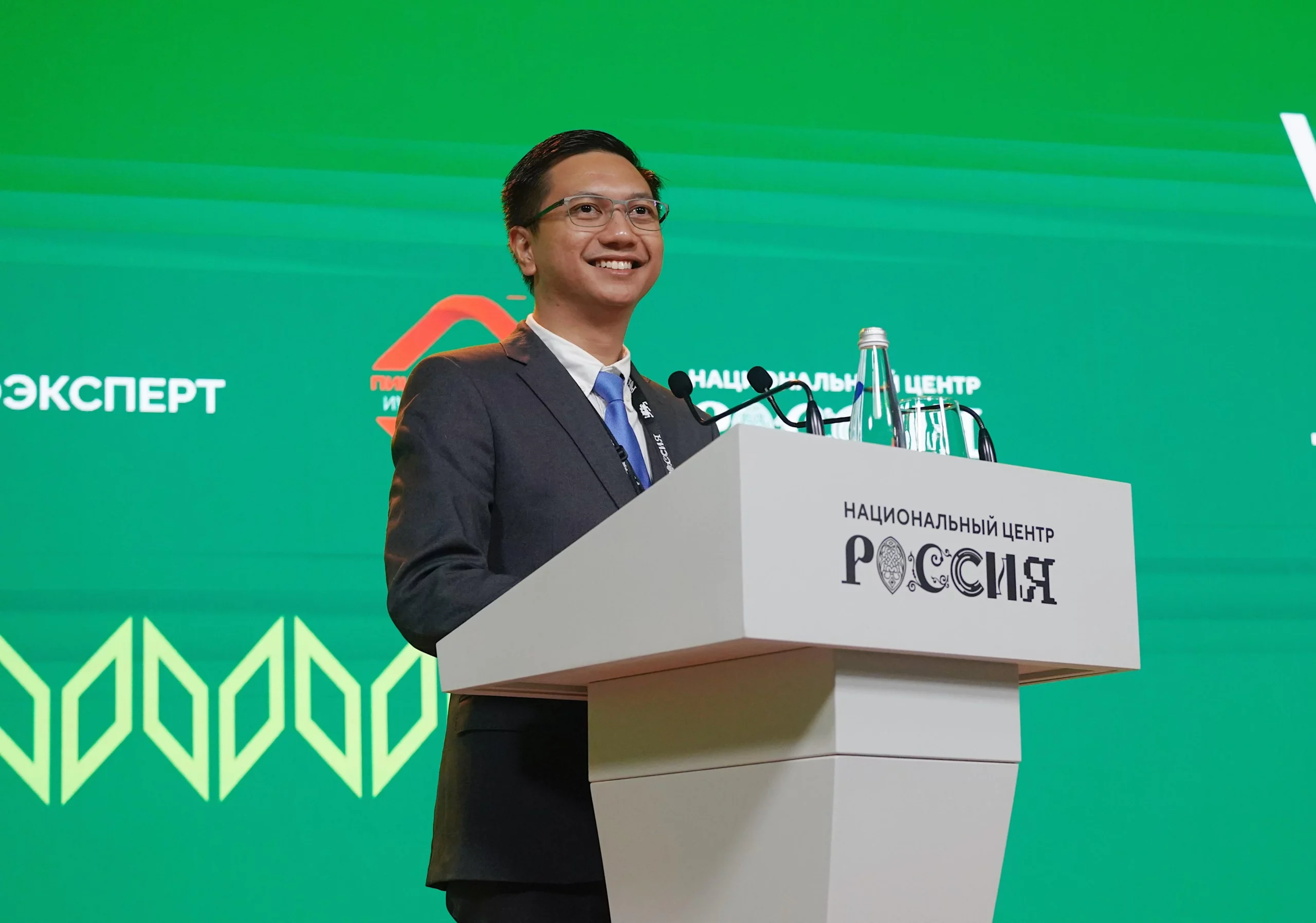
UNAIR NEWS – An academic from Universitas Airlangga (UNAIR) has represented Indonesia on the global stage. Dr. Arif Nur Muhammad Ansori, M.Sc., a young researcher from UNAIR’s Postgraduate School, served as a guest speaker at the 5th International Conference on Food Quality and Food Safety (FQFS), held September 23–25, 2025, at the National Centre Russia in Moscow.
The high-profile event was organized by RUDN University and the V.M. Gorbatov Federal Research Center for Food Systems of the Russian Academy of Sciences, with support from several international institutions. More than 35 countries took part, bringing together experts, academics, practitioners, and policymakers in the fields of food security and biosafety.
“It was an honor to represent Indonesia and UNAIR at this international forum. As a member of the Indonesian Young Academy of Sciences (ALMI), I was able to engage with young researchers from the Russian Academy of Sciences and strengthen collaboration with the V.M. Gorbatov Food Systems Research Center,” Dr. Ansori said.
Research focus
Dr. Anshori’s presentation centered on the Bovine Leukemia Virus (BLV), which affects cattle as a key food resource. He explained that BLV not only threatens livestock health but could also pose risks to global food security and economic stability if not properly addressed.
“We need accurate methods to detect this disease, including the use of DNA-based technology. In terms of food safety, this highlights the importance of innovation to maintain the quality of animal products while protecting public health,” he explained.
He also emphasized that infectious livestock diseases are part of a larger global health issue. BLV, he noted, is not solely a veterinary concern but also closely tied to food security and human health. His research reflects his expertise in virology, molecular biology, and infectious diseases.
“I also used this opportunity to introduce Indonesia and UNAIR by linking BLV to Indonesia’s strategic role in BRICS, which made the discussion even more relevant. My aim was to show that Indonesia is not just a technology consumer but an active contributor to scientific progress and innovation,” he added.
Future outlook
Dr. Anshori hopes his participation will open doors to further research collaboration, knowledge exchange, and broader opportunities for international publications. He also sees it as a step toward strengthening UNAIR’s reputation as a leading global university.
“Science serves as a bridge between nations. Through international research partnerships, we can tackle global challenges in health, food, and biotechnology. I hope this effort will bring meaningful benefits for Indonesia in advancing food security, global health, and its role within BRICS,” he concluded.
Author: Rifki Sunarsis Ari Adi
Editor: Khefti Al Mawalia