

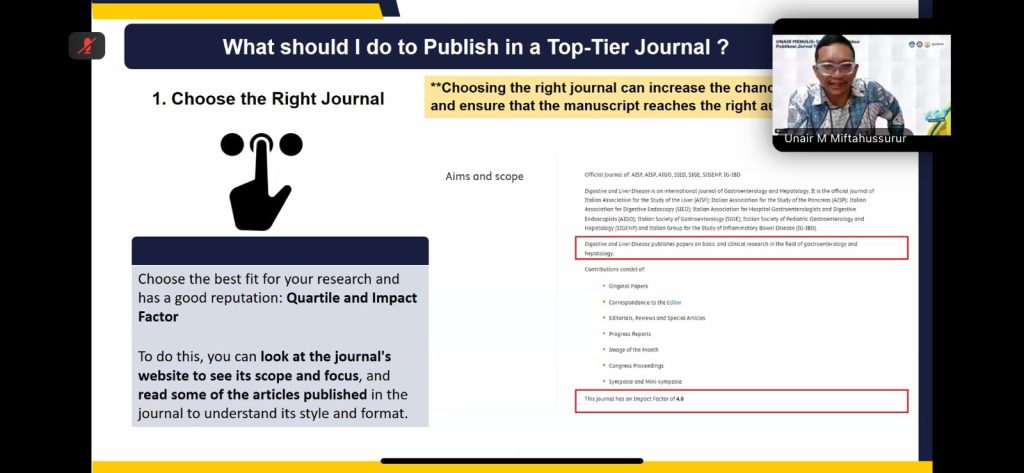
UNAIR NEWS – To boost research productivity and impact, Universitas Airlangga’s Institute for Journal Development, Publishing, and Intellectual Property Rights (LPJPHKI) held a special edition of its UNAIR Menulis program. Centered on the theme “Strategies for Breaking into Top-Tier Journal Publications,” the session aimed to strengthen academic writing and publication strategies among UNAIR faculty members and researchers.
Identifying leading journals across disciplines
The virtual event, held on Monday (Oct 6, 2025), featured UNAIR’s Vice Rector for Research, Innovation, and Community Development, Prof. dr. Muhammad Miftahussurur, M.Kes., Sp.PD-KGEH., Ph.D., as the keynote speaker. Prof. Miftahussurur emphasized that selecting the right journal is critical to successful publication. He urged researchers to identify reputable journals within their respective fields rather than focusing solely on quartile rankings.
“When you collaborate internationally, you’ll find that every field has its own well-regarded journals. Some may not be listed as Q1 or top-tier, but they are still influential,” he explained.
He also highlighted the importance of understanding a journal’s character and editorial preferences. “My mentor once advised me: if you plan to submit to Journal A, don’t analyze the bacteria—analyze the human aspect, because that’s what the editor prefers. Knowing such tendencies is key,” he said.
Collaborative strategies to reach top journals
Prof. Miftahussurur shared his experience publishing in Nature, explaining how he navigated the challenges of limited research facilities and funding in Indonesia. Instead of competing in pure biomedical studies, he strategically shifted his focus on Helicobacter pylori research to explore its role in predicting human migration—an area that caught the attention of a prominent research team at the Max Planck Institute in Germany.
“I knew that if I focused purely on pylori, I would lose out due to resource constraints,” he recalled. His team later collaborated with the German researchers, even conducting joint data analysis in Shanghai.
He emphasized that limited resources can be turned into opportunities through collaboration. “If we lack funding, we still have time. If we lack time, we have other resources. The key is to make the most of what we do have. That’s how we can reach top journals,” he asserted.
Novelty and significance set research apart
According to Prof. Miftahussurur, three elements determine whether a paper can make it into a top-tier journal: rigorous research methods, strong novelty and significance, and the journal’s overall reputation. He shared an example from his career, when he published research on a topic his professor had explored 15 years earlier. His professor’s study appeared in a journal with an impact factor of 10, while his was published in one with an impact factor of 3—simply because the novelty had diminished over time.
Meanwhile, Head of LPJPHKI Prof. Ferry Efendi, S.Kep., Ns., M.Sc., Ph.D., emphasized that the goal of UNAIR Menulis extends beyond increasing publication numbers. The focus, he said, is to produce impactful, high-quality research outputs.
“We hope to learn from Prof. Miftah’s experience—what practices we can adopt and adapt to improve our own publication performance,” Prof. Efendi concluded.
Author: Ahmad Abid Zhahiruddin
Editor: Khefti Al Mawalia