

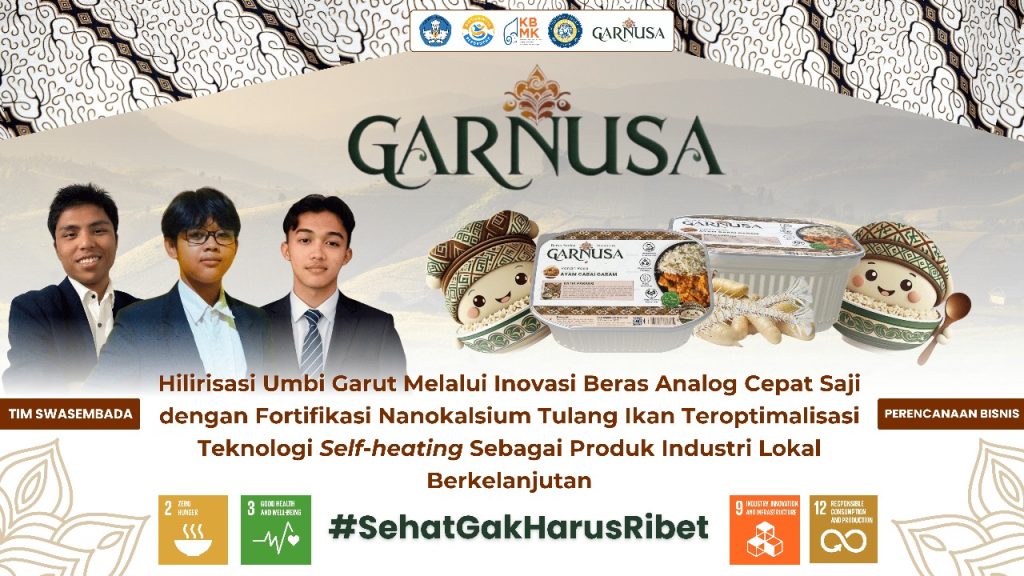
UNAIR NEWS – A team of Universitas Airlangga (UNAIR) students has achieved national recognition through their collaborative innovation. The Swasembada team—comprising Mohammad Pradana Setyawan (D4 Imaging Radiology Technology), Muhammad Kevin Mulki Hakim (Undergraduate in Industrial Engineering), and Irvan Betrando Banjarnahor (Undergraduate in Management) successfully advanced to the funding and presentation stage of the 2025 National Student Competition in Business, Management, and Finance (KBMK), organized by the Indonesian Ministry of Higher Education, Science and Technology.
Innovation from fish bone waste
Led by Irvan Betrando Banjarnahor, the Swasembada team introduced an innovation titled GARNUSA, an instant analog rice fortified with nano-calcium extracted from fish bones, supported by self-heating technology, and packaged in biodegradable materials. Banjarnahor admitted that he initially doubted the feasibility of their concept, but perseverance and teamwork ultimately paid off
“We once worked two days and nights without sleep to finish our paper. Although we don’t come from business backgrounds, we combined knowledge from different disciplines to produce an innovation that is both realistic and applicable to society,” he explained.
Hakim added that the project stemmed from growing societal challenges brought about by urbanization. As modern lifestyles become increasingly fast-paced, many people rely on fast food due to limited time, foods that often contain high glycemic indices.
In response, the Swasembada team proposed a solution through the downstream utilization of arrowroot, fortified with nano-calcium from fish bones and equipped with self-heating technology. Hakim explained that the product can cook itself without the need for conventional preparation, offering a healthier, more practical, and environmentally friendly food alternative. “We want to demonstrate that UNAIR students are capable of creating tangible, impactful solutions for the community,” he emphasized.
Broader impact on society
Beyond a simple food innovation, GARNUSA carries significant social and economic implications. Hakim noted that the product offers a healthy and safe instant food option suitable for all age groups. Moreover, it adds value to underutilized resources such as arrowroot tubers and discarded fish bones. “After finalizing our concept, we decided to incorporate biodegradable packaging to ensure that the product remains environmentally sustainable,” he added.
Hakim reaffirmed the team’s commitment to promoting sustainable development through Indonesia’s local fisheries and agricultural sectors. “We hope GARNUSA will drive the downstream development of arrowroot in Indonesia while increasing the economic value of fish bone waste,” he concluded.
Author: Muhammad Nabil Fawaid
Editor: Ragil Kukuh Imanto