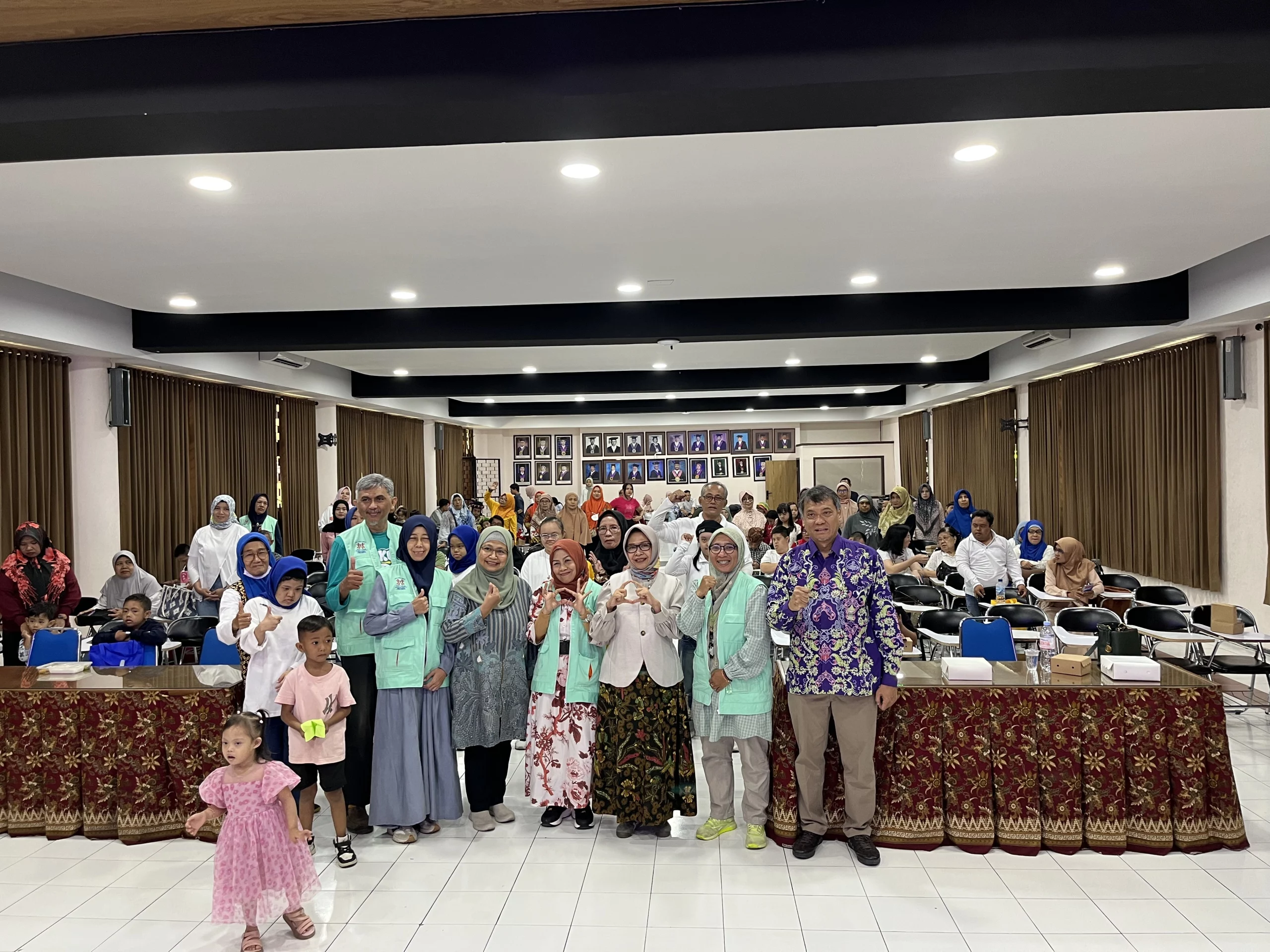
UNAIR NEWS – To commemorate Down Syndrome Awareness Month (DSAM) 2025, the Faculty of Public Health (FKM) Universitas Airlangga (UNAIR) joined a collaborative community outreach program organized by the Information and Activity Center of the Association of Parents of Children with Down Syndrome (PIK POTADS), East Java. The event, themed “Growing, Developing, and Meaningful,” featured an educational talk on Down syndrome with nutrition and psychology experts from UNAIR.
The activity took place on Saturday (October 18, 2025) at the Sumarno Hall, FKM Building, MERR-C Campus, UNAIR. On that occasion, Dean of FKM UNAIR, Prof. Ratna Dwi Wulandari, SKM, MKes, shared that this was the first event of its kind, adding a new dimension to the faculty’s community engagement efforts.
“This initiative aligns closely with the vision and mission of both FKM and UNAIR. As an educational institution, our responsibility extends beyond teaching, we are also called to contribute meaningfully to society. Through programs like this, we aim to make a real impact beyond the campus community,” Prof. Wulandari said.
Prof. Wulandari further noted that the program would provide valuable insights for parents of children with down syndrome. Parenting such children requires specific guidance and understanding from experts who specialize in their care and development.
“Every child is born special, and we must appreciate that uniqueness. Each child has potential that deserves to be recognized and nurtured,” she added.
Balanced nutrition for children with down syndrome
The event featured two speakers: Prof. Dr. Sri Sumarmi, SKM, MSi, and Muryantinah Mulyo Handayani, MPsych (Ed & Dev). The first speaker, Prof. Sumarmi, discussed nutrition that supports the growth and health of children with Down syndrome.
She explained that these children are more prone to metabolic disorders, which affect how the body converts glucose and fat into energy. This can lead to mitochondrial dysfunction, high oxidative stress, and insulin imbalance.
“Children with down syndrome have slower digestion compared to other children. Carbohydrates and fats are not always metabolized efficiently, making them more susceptible to obesity,” Prof. Sumarmi said.
The professor advised parents to be selective about their children’s diet, avoiding excessive carbohydrates, fats, and sugars. She recommended foods rich in zinc (Zn), selenium (Se), and calcium (Ca) to support better metabolism and overall health.
Supporting children through puberty
The second speaker, Muryantinah Mulyo Handayani, MPsych (Ed & Dev), discussed how to guide children with down syndrome as they enter puberty. This stage, she explained, brings significant biological and psychological changes—menstruation for girls and nocturnal emissions for boys. Parents play a crucial role in helping children recognize and understand these transitions early on.
“Parents need to help children understand puberty by teaching them about body parts and the changes they will experience. It’s equally important to explain the difference between public and private matters. Children must also learn proper hygiene, self-care, and how to identify safe and unsafe touch from others,” she said.
The UNAIR psychology expert emphasized the importance of using clear and concrete language when explaining puberty. She added that visual aids and role modeling are effective tools to help children with Down syndrome better grasp the concepts and develop healthy self-awareness.
Author: Selly Imeldha
Editor: Khefti Al Mawalia

