
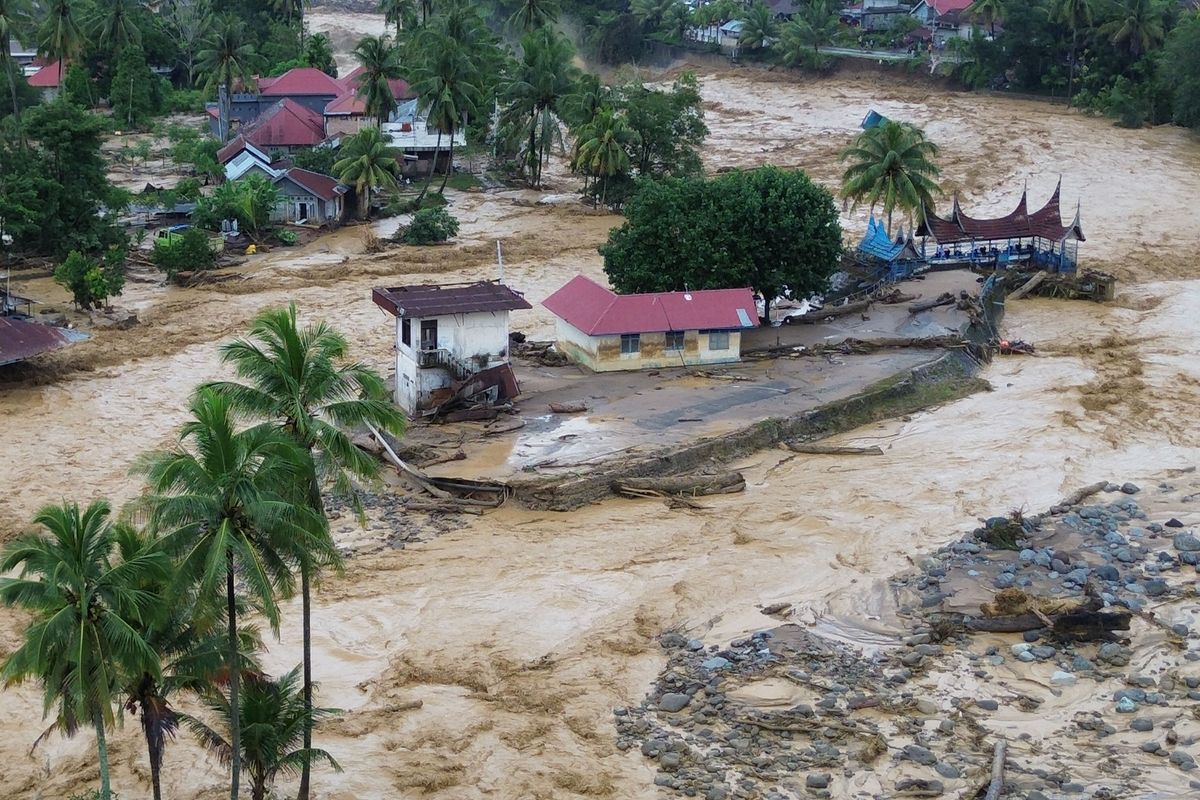
UNAIR NEWS – Severe floods and landslides have once again struck Indonesia, this time devastating parts of Sumatra, including Aceh, North Sumatra, and West Sumatra. The disasters have claimed hundreds of lives, caused extensive infrastructure damage, and left thousands displaced, drawing significant national and international concern.
Responding to the unfolding crisis, Dr. Hijrah Saputra ST MSc of Universitas Airlangga’s School of Postgraduate Studies offered his perspective. He explained that the disaster is part of an increasingly extreme Southeast Asian weather system and is linked to shifting rainfall patterns, a trend echoed by similar floods in Malaysia.
“The main trigger is exceptionally heavy rainfall caused by Tropical Cyclone Senyar and a developing cyclone in the Malacca Strait, both of which also fueled major flooding across several Malaysian states. Conditions in Sumatra worsened due to environmental factors such as deforested slopes, settlements near riverbanks, inadequate drainage, and critical infrastructure that has not yet adapted to these risks,” he said.

Deforestation concerns
Beyond the immediate flooding and landslides, Dr. Saputra also drew attention to widespread logging in upstream watershed areas as a key aggravating factor. Trees, he emphasized, play a vital role in storing groundwater and stabilizing soil structures that prevent landslides.
“Videos and photos circulating online show large amounts of timber washed into rivers and along the coast. This is not a natural occurrence, it signals uncontrolled logging activity. Deforestation reduces water absorption, increases surface runoff, and heightens landslide vulnerability,” he asserted.
Mitigation measures
Dr. Saputra acknowledged the government’s swift emergency response, including helicopter and naval evacuations, logistics distribution, power restoration, and weather modification efforts. These actions, he said, reflect a generally effective short-term disaster response. Still, he noted shortcomings in long-term preparedness.
“Long-term mitigation remains weak. Early-warning systems have not reached remote villages,
spatial planning is still poorly enforced, and environmental restoration is inconsistent. Short-term response has been relatively quick, though some areas that are geographically difficult to reach experienced delays,” he said.
Dr. Saputra outlined the need for concrete actions across three phases. First, short-term efforts should prioritize 72-hour SAR operations, logistics supply, and medical services. Second, medium-term steps include assessing damage, repairing infrastructure, and relocating residents from high-risk zones. Third, long-term strategies must focus on watershed rehabilitation, slope reforestation, river normalization, and integrating mitigation into regional development plans.
“This is not simply fate, it reflects how we manage our environment and the readiness of our systems. If we want to reduce casualties in the future, resilience must start with disciplined spatial planning, healthy watershed ecosystems, and regionally integrated early-warning systems,” he concluded.
Author: Rifki Sunarsis Ari Adi
Editor: Khefti Al Mawalia