

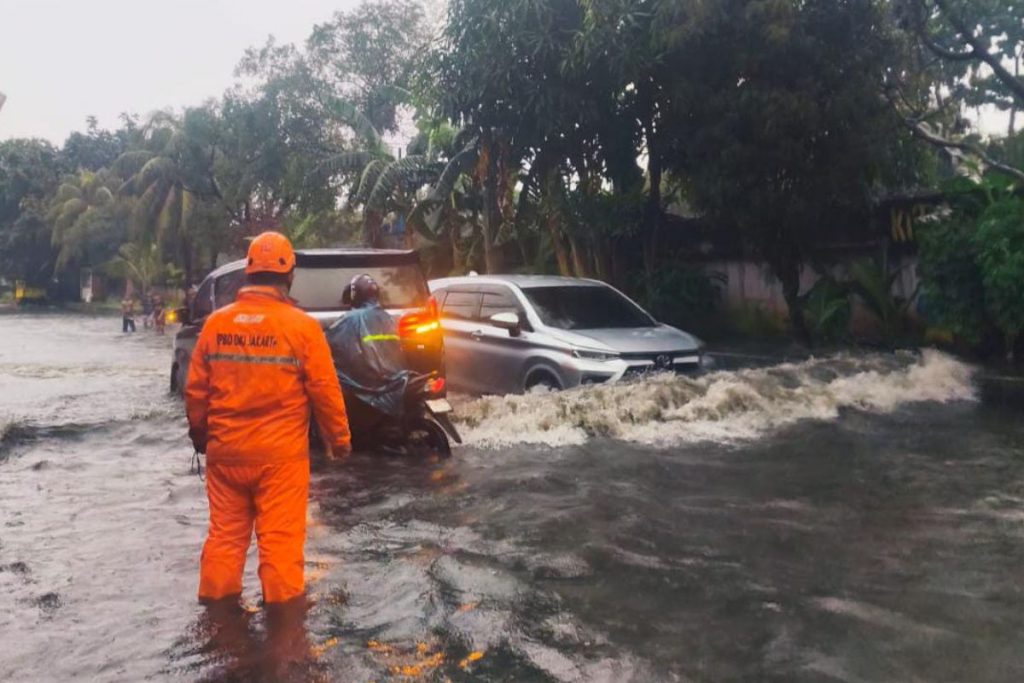
UNAIR NEWS – Tidal flooding is expanding across Indonesia’s coastal areas. While the phenomenon is driven by natural tidal cycles, its growing impact on daily life has elevated it to a serious hazard that requires sustained attention. This warning was delivered by Dr. Eng. Sapto Andriyono, S.Pi., M.T., a lecturer at the Faculty of Fisheries and Marine Sciences.
Dr. Andriyono explained that tidal flooding typically affects coastal zones with elevations lower than peak tidal levels. Such vulnerable topography is common along Java’s northern coastline, including several areas in North Surabaya.
“Not all coastal regions experience tidal flooding, but areas with land elevations below high-tide levels are extremely vulnerable. In North Surabaya, for instance, several locations are already situated below the level of maximum sea tides,” he said.
He added that floodwaters tend to linger longer during the rainy season, when high tides coincide with heavy rainfall. This combination slows water drainage and prolongs inundation, disrupting multiple sectors, from economic activity to education.

Land conversion shrinks natural absorption areas
Tidal flooding, Dr. Andriyono noted, is further intensified by large-scale development in coastal regions. Areas that once served as natural water absorption zones, including mangrove forests, have increasingly been converted into residential neighborhoods, warehouses, and industrial complexes.
“These absorption zones are critically important. Yet many mangrove areas have been transformed into housing and industrial sites. When these natural buffers disappear, seawater pressure pushing inland becomes much stronger,” he explained.
He stressed that mangrove forests are among the most effective natural defenses against tidal flooding. Their high tolerance to saline conditions allows them to function as protective barriers before seawater reaches populated areas. “Mangroves are ideal, few ecosystems can withstand such salinity. In Surabaya, the mangrove green belt should be reinforced and expanded,” he said.
Sea walls are not always the answer
Although sea walls are often promoted as a quick solution, Dr. Andriyono cautioned that they can create new problems. Concrete barriers may disrupt ocean currents, alter wave behavior, and trigger erosion or sediment buildup in neighboring areas.
In addition to tides and rainfall, intensive construction has accelerated land subsidence along the coast. Dr. Andriyono cited research suggesting that parts of northern Java could disappear within a few decades if subsidence is not brought under control.
Widespread development has also driven seawater intrusion farther inland, displacing freshwater aquifers and making access to groundwater increasingly difficult for coastal communities.
“The more development there is, the greater the seawater intrusion, pushing freshwater resources farther away. Eventually, even digging freshwater wells will become a challenge,” he said. Dr. Andriyono emphasized that effective tidal flood mitigation must be supported by public education and urban planning that takes coastal ecosystem conditions into serious account.
Author: Rizma Elyza
Editor : Khefti Al Mawalia