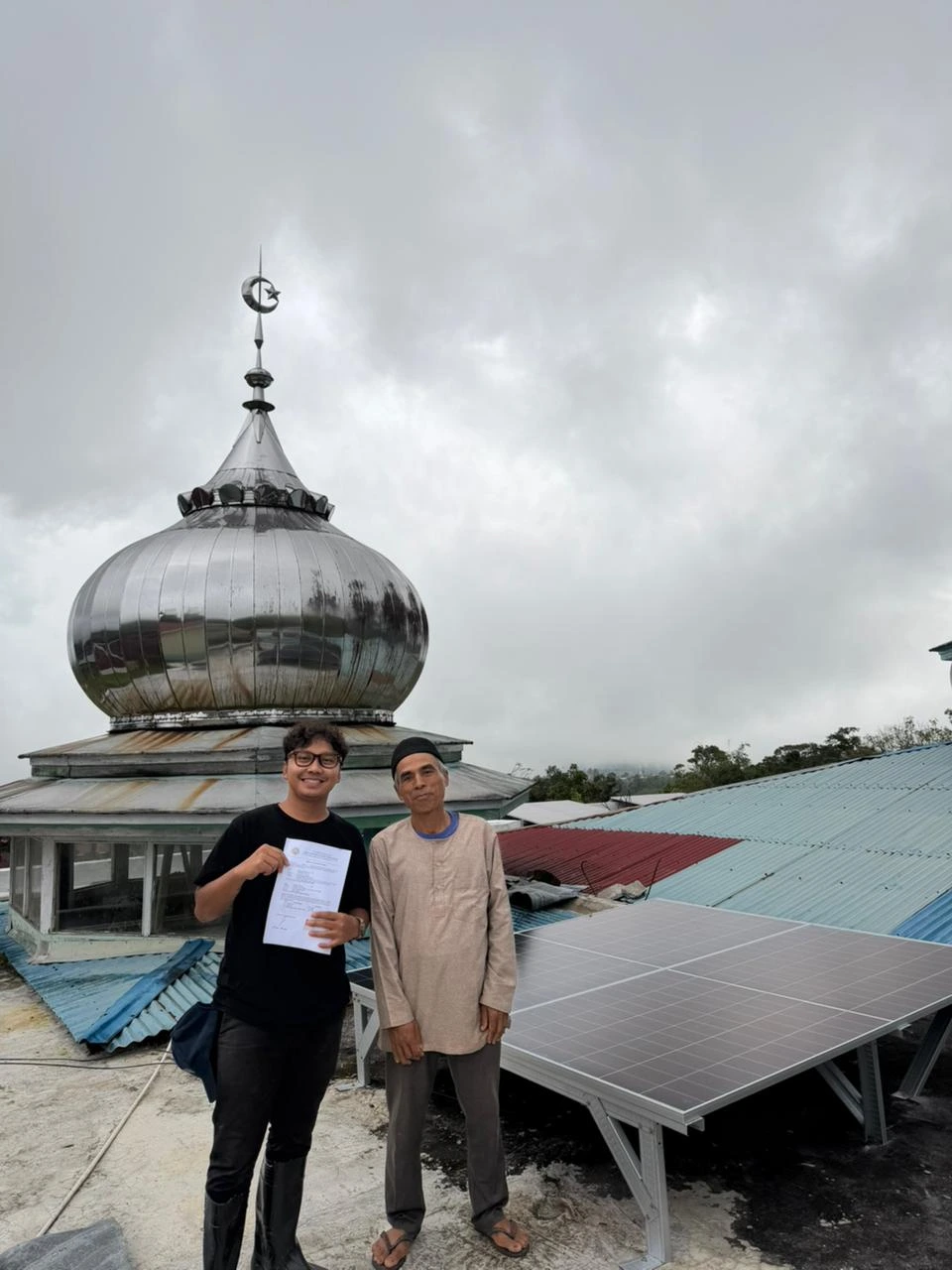
UNAIR NEWS – Against the backdrop of homes damaged by flash floods and landslides, Universitas Airlangga (UNAIR), through its Disaster Emergency Response Team, has delivered renewed optimism to affected residents. That effort was led by a lecturer and students from the Faculty of Advanced Technology and Multidiscipline (FTMM), who on Wednesday (17/12/2025) installed solar panels and a Starlink satellite communication system in a disaster-affected area. The installation took place in Jorong Limo Badak, Malalak Subdistrict, Agam Regency, West Sumatra.
Yoga Uta Nugraha, ST, MT, an FTMM lecturer who worked directly on site, said the location was selected following recommendations from the Agam Regency Government and the National Disaster Management Agency (BNPB). Malalak Subdistrict, he noted, is among the areas hardest hit by the disaster in West Sumatra.
“We conducted field surveys in Malalak Subdistrict and assessed conditions firsthand. From there, we identified Limo Badak Hamlet as a priority location. The area is situated on a hillside and is home to about 220 households. A mosque there serves as a gathering point, evacuation site, relief post, and communal kitchen for affected residents,” he explained.

Addressing energy and communication gaps
Nugraha said the team quickly identified an urgent need for electricity, which had also caused local communication networks to shut down. “For several days after the disaster, residents had no power, which meant they also lost access to communication. That is why we installed solar panels along with a Starlink network at the mosque,” he said.
The team installed solar panels with a capacity of approximately 5,000 watt-peak (Wp). According to Nugraha, the system is sufficient to power water purification pumps installed by the UNAIR Faculty of Science and Technology (FST) team, while also supporting electricity needs at the communal kitchen. “This setup provides an independent power source. When the main grid goes down, essential systems can still operate using solar energy,” he added.
The FTMM initiative reflects support for several Sustainable Development Goals (SDGs). The solar power installation aligns with SDG 7 on Affordable and Clean Energy, while the deployment of resilient communication technology such as Starlink supports SDG 9 on Industry, Innovation, and Infrastructure.
Reviving community life

Nugraha added that the combined presence of solar panels, Starlink connectivity, and water filtration systems is expected to accelerate the community’s recovery, economically, socially, and educationally. “Because the mosque functions as the center of many community activities, including schooling, the impact will be significant for teachers and children in Limo Badak. Local leaders will also be able to communicate more effectively with higher levels of government,” he said.
He expressed hope that reliable energy and communication access would help residents rebound from the disaster, while also reducing health risks linked to contaminated water and poor sanitation. “Stable electricity and communication are essential so the community can gradually return to normal daily activities,” he emphasized.
Through these post-disaster recovery efforts, UNAIR, through FTMM, has also contributed to advancing SDG 11 on Sustainable Cities and Communities, supporting the development of more resilient, disaster-ready communities.
Author: Yulia Rohmawati