

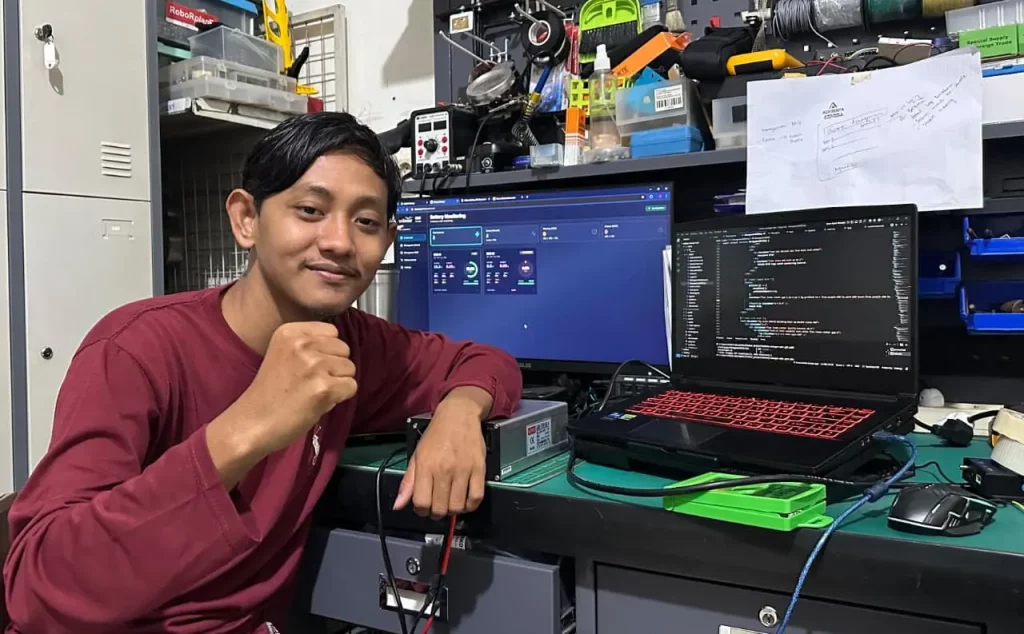
UNAIR NEWS – Academic experiences and student activities during their time at Universitas Airlangga (UNAIR) have proven instrumental in shaping alumni careers. This is evident in the professional path of Moch Ihwanul Abidin Dwi Tama, an alumnus of the Robotics Engineering and Artificial Intelligence program at FTMM UNAIR, who is now working as a software engineer at PT Adhikara Wiyasa Gani.
Valuable experience
While studying at FTMM UNAIR, Tama actively expanded his skills through a wide range of activities, including student organizations, competitions, and internships. His interest in technology began to take shape when he joined UNAIR’s robotics team for the Indonesian Robot Contest (KRI). Through the team, he assumed several technical roles, ranging from CAD design for the Indonesian Dance Robot Contest (KRSTI) to manufacturing for the Indonesian Flying Robot Contest (KRTI) and mechanical systems for the Indonesian Robot Soccer Contest (KRSBI).
He was also involved in collaborative projects with the Electrical Engineering department at UNAIR. “I worked on a project with the Electrical Engineering team involving a solar panel cleaning robot, known as the Arvos robot. I handled the electrical and mechanical components, and this experience later became the foundation for applying my electrical knowledge during my internship,” he said.
With this background, Tama applied to the Kampus Merdeka Competitive Program (PKKM) organized by the Ministry of Education, Culture, Research, and Technology, now the Ministry of Higher Education, Science, and Technology. Through the program, he secured an internship as an electrical technician at PT Adhikara Wiyasa Gani, where he also gained exposure to software development work.
“My transition into software engineering started when I helped a colleague who was responsible for programming. At first, I only assisted with basic tasks, but over time I began to understand the logic and algorithms behind the work,” he explained.
Tama continued to sharpen his skills and later earned the opportunity to contribute to a project with direct relevance to UNAIR, known as the UNAIR Bike initiative.
“In that project, I was responsible for assembly and electrical systems, as well as encrypting sensor data that was later integrated into software and developed into an application available on both the App Store and Play Store,” he said.
Tangible contributions
Over nearly three years at PT Adhikara Wiyasa Gani, Tama has worked on a range of technology projects involving both academic institutions and industry partners. His responsibilities included developing and maintaining systems used by several universities in Surabaya, such as the Sepuluh Nopember Institute of Technology, the Surabaya State Electronics Polytechnic, and Universitas Airlangga.
“More recently, I conducted research on building usage monitoring and control through SIPEGI, UNAIR’s energy-saving system. I also worked with PT Wilmar Nabati Indonesia on a battery monitoring system for shuttle robots used to transport goods in their warehouse,” he said.
Tama encouraged students interested in software development to remain curious, keep learning, and be willing to take risks. He stressed the importance of not becoming overly dependent on artificial intelligence (AI), but instead learning how to use it strategically.
“In the workplace, AI can offer input, suggestions, or recommendations based on the problems I’m working on. But no matter how advanced AI is, it still requires the right keywords and clear problem definitions to be used effectively,” he concluded.
Author: Selly Imeldha
Editor: Khefti Al Mawalia