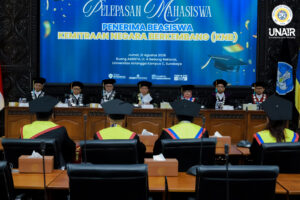


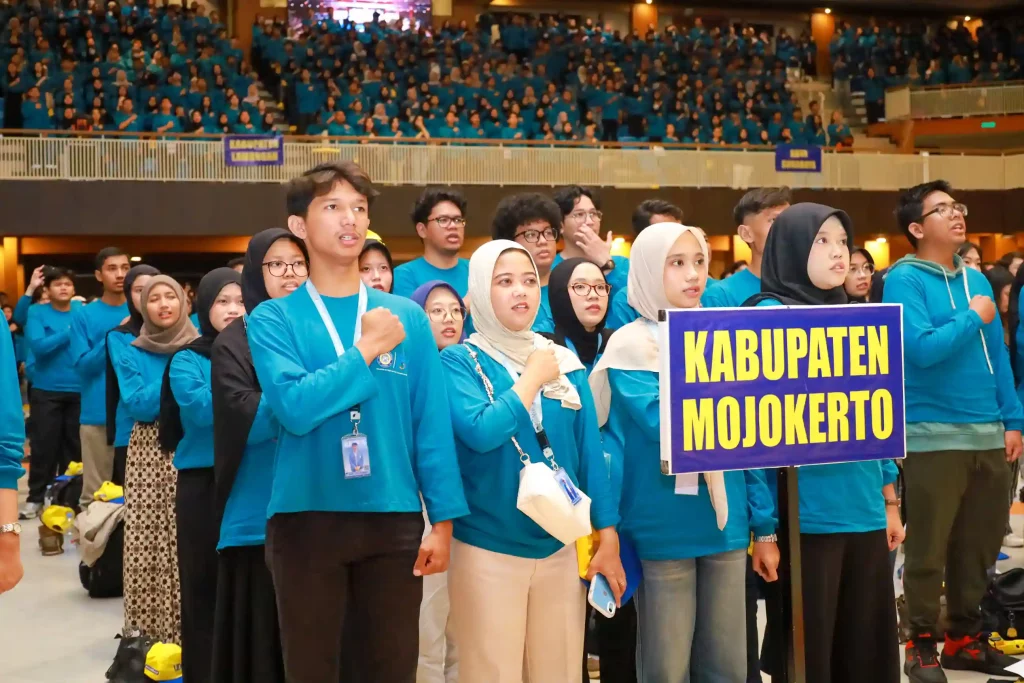
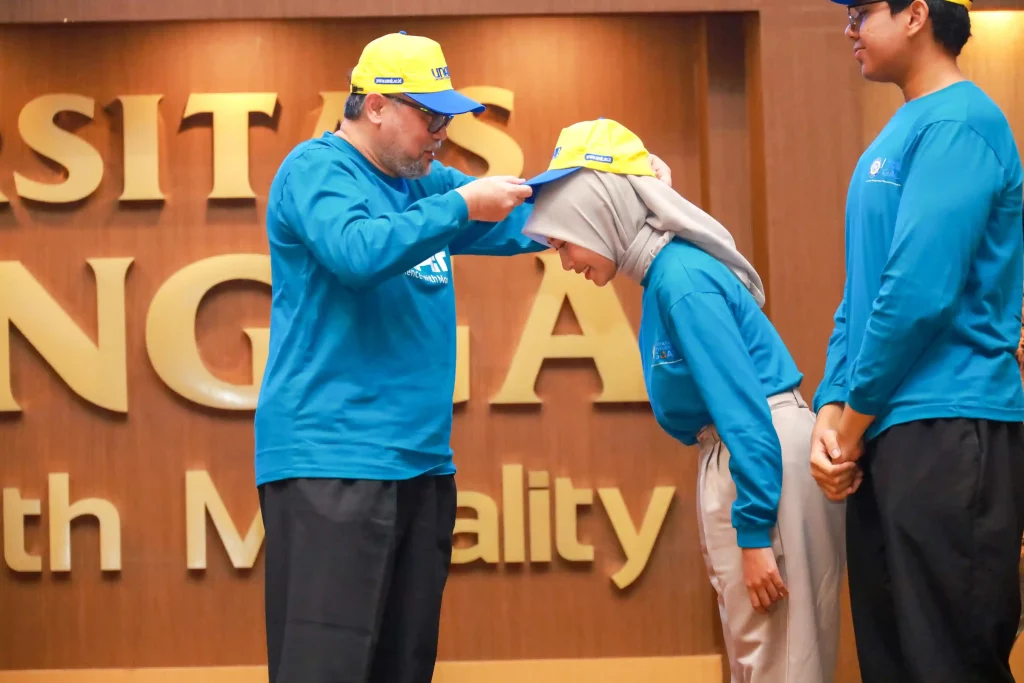
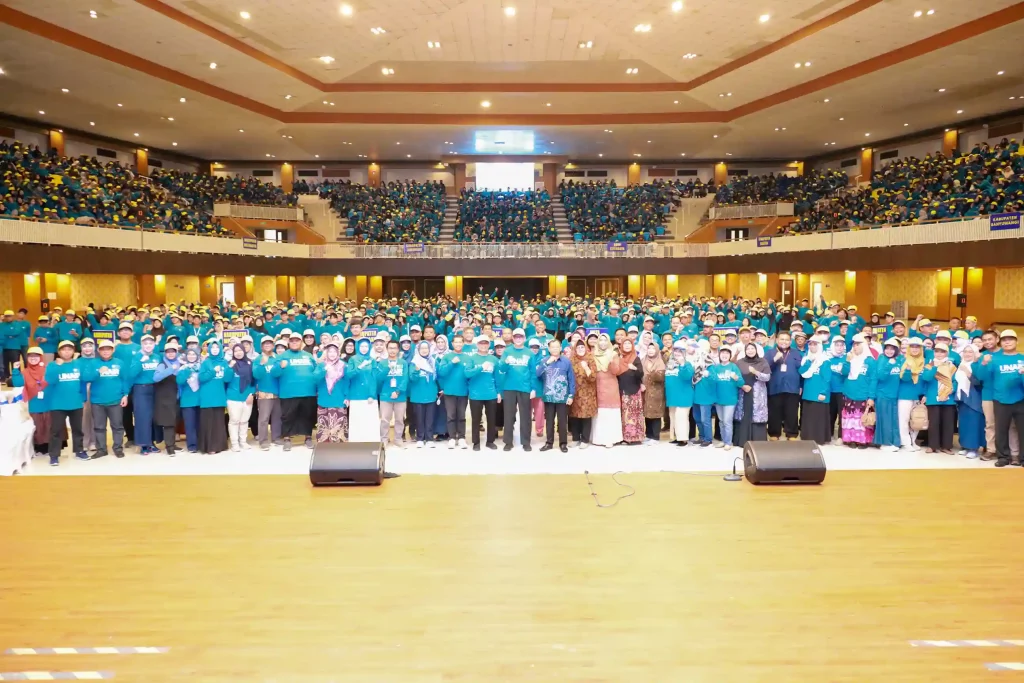
UNAIR NEWS – Universitas Airlangga (UNAIR) has again deployed its students to take part in community service through the seventh cycle of the Learning with Community (BBK) program. This year, a total of 2,716 students were assigned to six regencies and cities, Surabaya, Madiun, Gresik, Mojokerto, Lamongan, and Banyuwangi. Beyond the regional program, UNAIR also sent 62 students abroad under the international BBK scheme to Malaysia and Japan. The send-off ceremony took place on Monday, Jan 5, 2026, at the Airlangga Convention Center (ACC), MERR-C Campus, UNAIR.
Building resilience and real impact
Speaking at the event, Vice Rector for Academic, Student, and Alumni Affairs (AMA) Prof. Ir. Mochammad Amin Alamsjah, MSi, PhD, said the BBK program serves as a bridge between academic learning and real-world application. He emphasized that BBK allows students to move beyond the classroom and apply their knowledge directly within communities.
The professor from the Faculty of Fisheries and Marine Sciences (FPK) also urged students to uphold the university’s core value of excellence with morality. He reminded them to protect UNAIR’s reputation and to demonstrate resilience and meaningful contributions throughout their service. He hoped that the BBK 7 program would run smoothly and achieve its intended objectives without disruption.
SDGs take center stage
Head of the Institute for Sustainable Community Service (LPMB) Prof. Hery Purnobasuki, MSi, PhD, noted in his report that this year’s BBK program marks a step forward from previous editions. Running from January 5 to February 2, the program is designed around sustainable initiatives that align closely with UNAIR’s commitment to the Sustainable Development Goals (SDGs).
“This seventh BBK is structured with the SDGs as its main priority. It underscores UNAIR’s commitment to ensuring that its performance and policies consistently support the achievement of the SDGs,” he said.
“The villages where students carry out their service are entrusted with flagship programs that are intended to be sustainable. In other words, these programs must be completed and generate tangible impacts for the respective regions,” he continued.
Echoing earlier remarks, Prof. Purnobasuki reiterated that students serve as ambassadors of the university throughout the program. He stressed that their work would shape not only community outcomes but also UNAIR’s public image. “We hope the students perform well in the field, contribute meaningfully, and return safely at the end of the program,” he said.
Author: Yulia Rohmawati