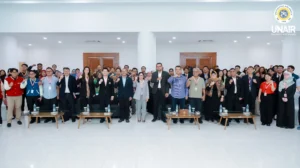


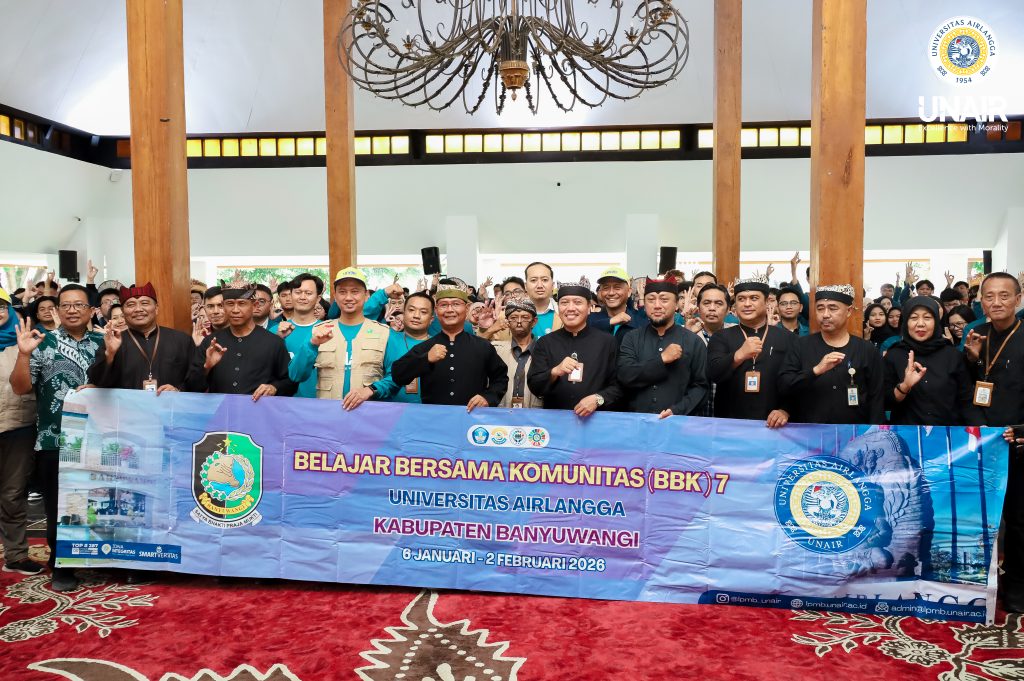
UNAIR NEWS – Universitas Airlangga (UNAIR) continues to reinforce its commitment to community service through programs aligned with the Sustainable Development Goals (SDGs). Through its Institute for Sustainable Community Service (LPMB), UNAIR officially deployed 366 students participating in the Community Service Program to Banyuwangi Regency on Tuesday, January 6, 2026. The deployment ceremony was held at Pendopo Sabha Swagata Blambangan.
The 366 students will carry out community service activities across six sub-districts and 41 villages in southern Banyuwangi. Unlike previous years, this year’s KKN implementation is grounded in all 17 SDGs as the primary framework for engagement. Students have been instructed to design and implement programs that align directly with SDG objectives.
Supporting SDGs commitment
Vice Dean I of the Faculty of Health Sciences, Medicine, and Life Sciences (FIKKIA) at UNAIR Banyuwangi, Ivan Rahmatullah, MD, MPH, PhD, emphasized that the KKN program reflects UNAIR’s commitment to translating the SDGs into action at the grassroots level. “The deployment of 366 students across six sub-districts demonstrates UNAIR’s dedication to community service while also contributing to global SDG performance. Achieving the SDGs is not solely an institutional goal, but a shared responsibility that must be realized within communities,” he said.
He explained that this year’s KKN program focuses on four main areas: health, education, economy, and environment. These focus areas will be integrated with Banyuwangi Regency’s flagship initiatives, particularly the Banyuwangi Hijau program.
“We hope students can serve as role models in their surroundings and show that young people are agents of change. As UNAIR ambassadors in Banyuwangi, KKN students are expected to make concrete contributions, including efforts to reduce poverty and improve human development indicators,” he added.

Emphasis on Banyuwangi Hijau Program
In the same vein, Assistant Regional Secretary I of Banyuwangi Regency, M. Yanuarto Bramuda, S.Sos., MBA, MM, expressed appreciation for UNAIR’s continued trust in selecting Banyuwangi as a service location. He noted that southern Banyuwangi holds significant potential for further growth through collaboration with higher education institutions.
“We extend our highest appreciation to UNAIR. The six sub-districts hosting the KKN program show solid economic growth, each with distinct strengths ranging from tourism to agriculture. Students can work alongside communities to help further develop these villages,” he said.
Bramuda also highlighted the importance of student involvement in supporting the Banyuwangi Hijau program, particularly through environmental education and waste management initiatives. He stressed that waste-related challenges, especially in coastal areas, require collective awareness and community participation.
“Over the next month, we hope students can help raise public awareness, including on proper waste management. If waste is not handled properly, debris from the sea will eventually return to the shoreline, especially during the west monsoon season,” he explained.
Economic impact contributions
Bramuda further noted that the presence of UNAIR’s academic community in Banyuwangi contributes not only to improving human resource quality but also to stimulating the local economy. “The arrival of students from various regions creates a tangible economic impact for the people of Banyuwangi. Universities do not only produce skilled human capital, but also help drive local economic activity,” he said.
He expressed hope that UNAIR’s KKN program would serve as a strategic partner for the regional government in advancing sustainable development initiatives. With students acting as external observers, challenges at the village level can be identified and addressed more quickly.
“Banyuwangi Hijau represents the local government’s long-term commitment to environmental preservation, improving quality of life, and sustainable waste management. We hope UNAIR KKN students can make meaningful contributions and strengthen public awareness so that the program’s impact can be sustained,” he concluded.
Author: Khefti Al Mawalia