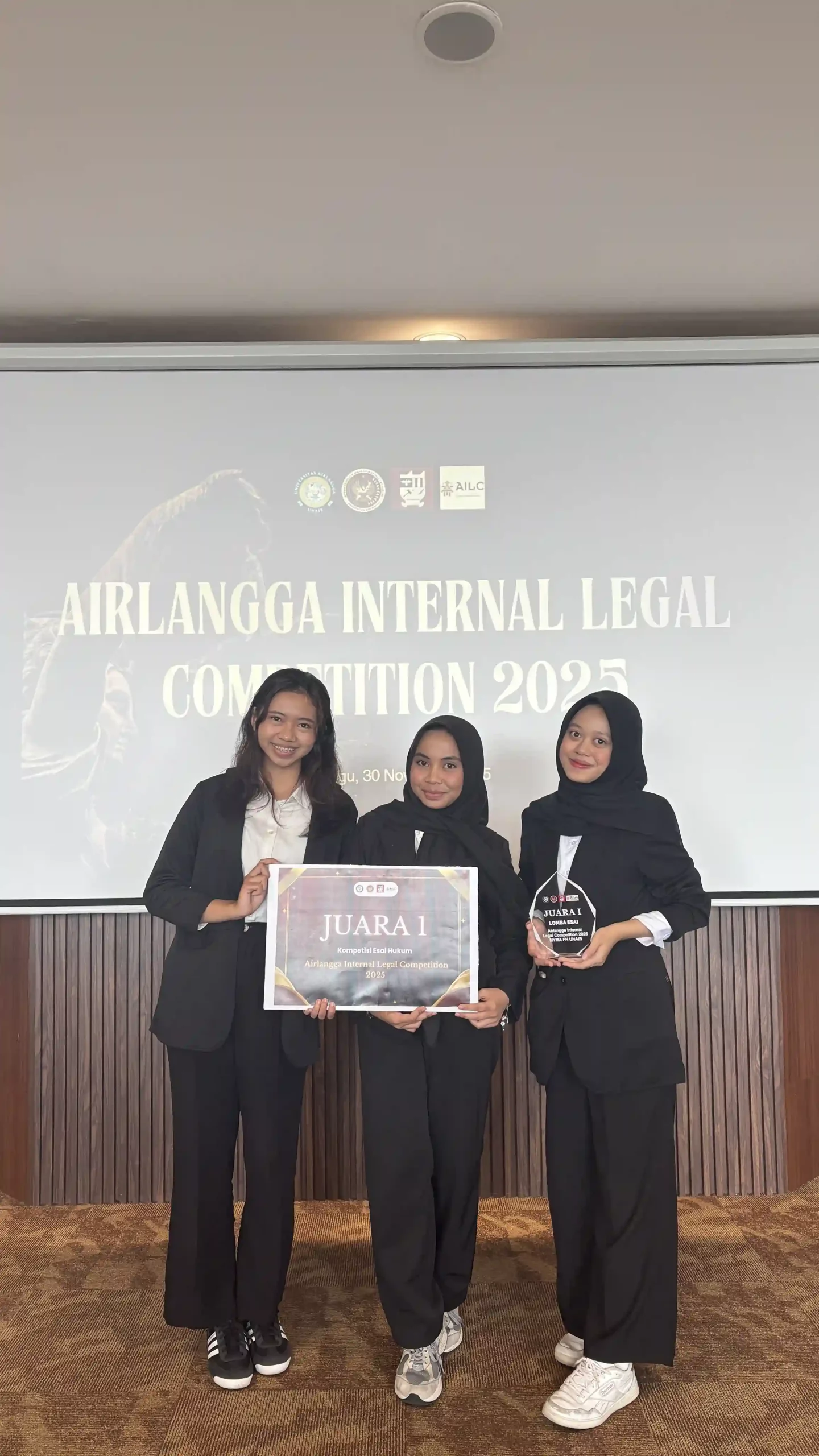
UNAIR NEWS – The Owen Hood Philips Team secured first place in the Airlangga Legal Essay Competition as part of the 2025 Internal Legal Competition. The team consists of Kayla Najmina Syamila, Widya Elora Indriani, and Sera Amalia Rasyida, students from the Class of 2025 in the Law Study Program, Faculty of Law, Universitas Airlangga. Through a critical legal essay, the team examined the issue of cross-border transfers of Indonesian citizens’ personal data to the United States and the constitutional responsibility of the state to safeguard citizens’ right to privacy.
The team was formed unexpectedly. All three students shared an interest in participating in the competition but had not yet assembled a complete team. Their collaboration began through a post on the social media platform X, which brought them together and ultimately led to their successful partnership and achievement.
Personal data transfer issues and global relevance
In their essay, the Owen Hood Philips Team addressed the issue of the state’s constitutional accountability in regulating cross-border personal data transfers. Their essay, titled “Reforming Personal Data Protection Policies in Response to the Challenges of Legal Ambiguity in National Law,” was selected in response to the rapid pace of digitalization, which has rendered cross-border data transfers inevitable while simultaneously posing potential threats to citizens’ privacy rights.
The issue is highly relevant to both national and global legal developments, particularly due to the lack of clear regulatory standards in Indonesia regarding data-receiving countries and the suboptimal role of the Personal Data Protection Authority. Limited transparency in data transfer practices also reflects the dominance of economic interests, which may undermine the constitutional rights of citizens.
Methodology, challenges, and future outlook
In developing their argument, the team structured their analysis from general to specific by outlining the chronology of data transfers to the United States. They then conducted a doctrinal analysis of the 1945 Constitution of the Republic of Indonesia and the Personal Data Protection Law. The research employed a normative juridical approach, using the principles of informational self-determination and data sovereignty as analytical frameworks, complemented by a comparative study of international regulations such as the General Data Protection Regulation (GDPR).
The primary challenges faced by the team involved time constraints and the need to harmonize technological considerations, cross-border dynamics, and national legal foundations, all of which required meticulous source validation. Throughout the writing process, the team received guidance from a senior member of MYMA (Masyarakat Yuris Muda Airlangga), Natalia Putri. Additional feedback was provided by Muhammad Irfan Permana, Nadirah Dinta, and William Widjaya. Winning first place proved to be a valuable experience for the team and is expected to inspire other students to step beyond their comfort zones.
Author: Dara Devinta Faradhilla
Editor: Ragil Kukuh Imanto

