

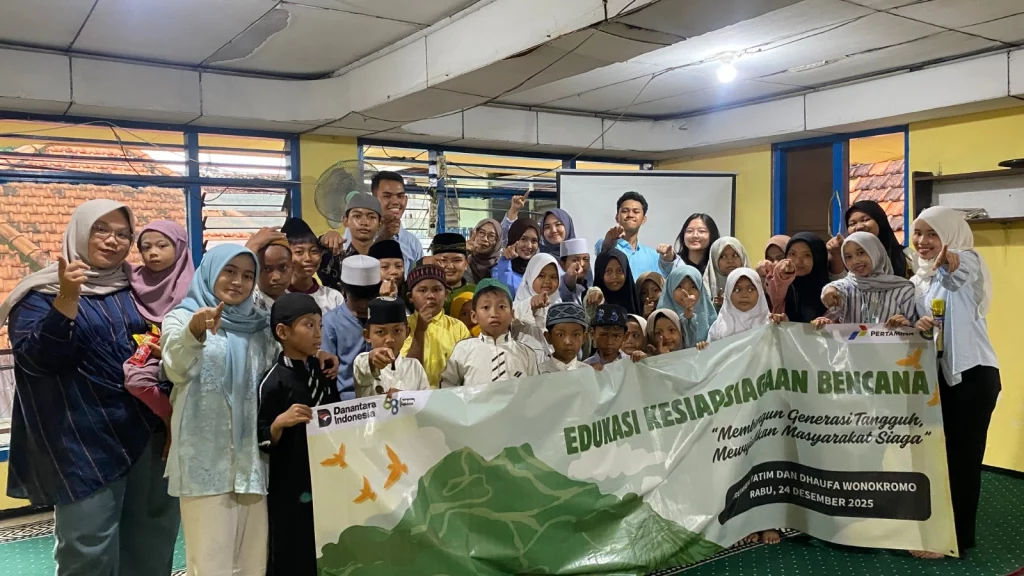
UNAIR NEWS – Students of Universitas Airlangga (UNAIR) who receive the Pertamina Sobat Bumi Scholarship (FPS) Batch 12 once again demonstrated their social and environmental commitment through a disaster readiness initiative held on Wednesday, December 24, 2025. The program was conducted alongside FPS’s environmental contribution through a Tree-Planting Initiative and took place at Rumah Yatim Dhuafa Wonokromo.
Qonitah Tsaniyah, a member of the organizing committee, explained that Sobat Bumi carried out two integrated activities: the Tree-Planting Initiative and the Disaster Readiness Initiative. Both programs were supported by the Pertamina Foundation and involved several volunteers. “Our goal is to provide education on disaster preparedness—how people should respond to emergencies, how to protect the environment, and how to prevent disasters such as flooding,” Tsaniyah said.
Activity preparation and challenges
The educational sessions addressed appropriate responses to natural disasters, including earthquakes and tsunamis, as well as human-caused disasters such as floods and fires. The program also highlighted the role of environmental stewardship in reducing disaster risks. According to Tsaniyah, the expected outcome was for participants to gain a clear understanding of self-evacuation procedures and emergency supply preparation.
“We also hope the children at Rumah Yatim Dhuafa Wonokromo can recognize their basic needs during a disaster and appreciate the importance of being prepared from an early age,” Tsaniyah emphasized.
Mochammad Narendra Putra Nazar added that the preparation process was completed within just one week. The team began with a site survey, followed by audience analysis, material development, and close coordination with the orphanage management and relevant parties. “During the event, we delivered the material in an interactive way through disaster-themed storytelling, presentations, and a ‘disaster preparedness bag’ game that encouraged children to identify and arrange essential emergency items,” Nazar explained.
Despite the enthusiastic atmosphere, the activity faced several challenges. At one point, the electricity at the venue went out, as the event was held in a local prayer hall with limited facilities. The situation was resolved through effective coordination with residents and neighborhood leaders, allowing the program to continue once power was restored.
Impact of disaster readiness initiative
The initiative generated tangible benefits. Children became more aware of the importance of disaster preparedness and environmental responsibility, while local residents felt included in a collaborative community effort. Over the long term, programs like this have the potential to inspire similar disaster education and environmental conservation initiatives in other regions of Indonesia.
“On a broader scale, activities like this could serve as a model for disaster education and environmental preservation programs elsewhere. The impact doesn’t have to stop at one orphanage or a single location—it can reach a much wider audience across Indonesia,” Nazar said.
In closing, Tsaniyah encouraged UNAIR students not to hesitate in initiating community service efforts. Beyond creating direct benefits for communities and the environment, such activities help build empathy, expand perspectives, and strengthen students’ sense of social responsibility as future agents of change. “There’s a real sense of happiness that comes from being able to help others, especially children in orphanages. At the same time, we learn how to collaborate with many stakeholders, the children, caretakers, volunteers, and even local neighborhood leaders,” Tsaniyah concluded.
Author: Muhammad Nabil Fawaid
Editor: Ragil Kukuh Imanto