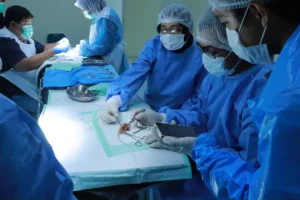


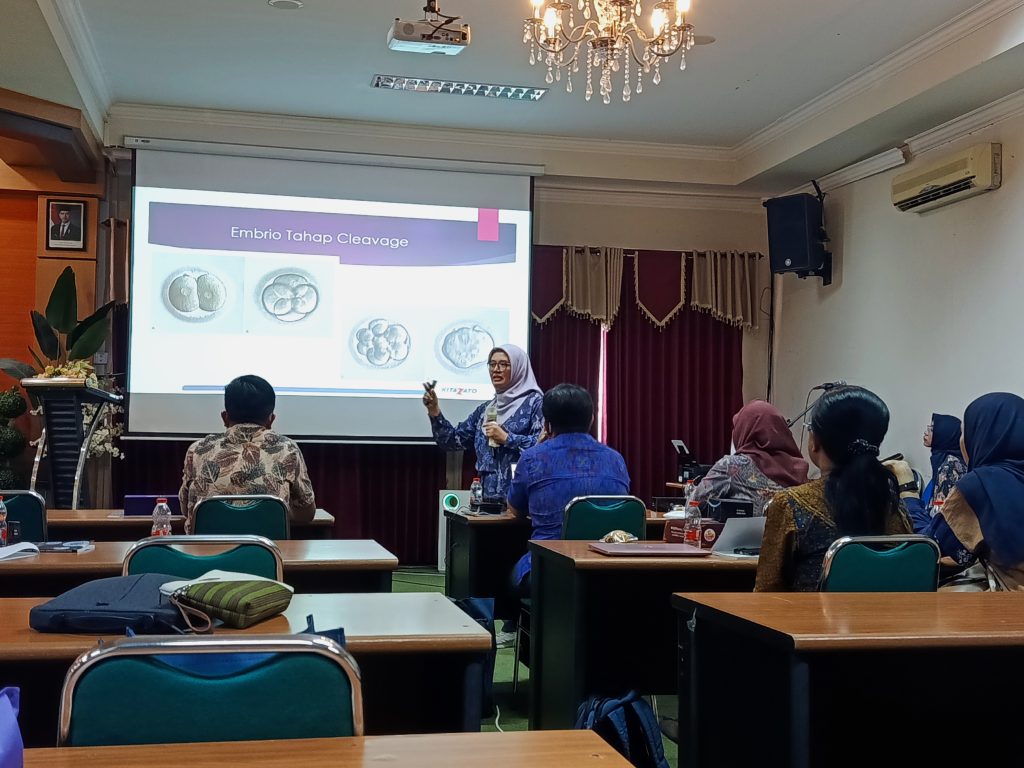
UNAIR NEWS – Artificial insemination is widely used to produce offspring, particularly in livestock breeding. However, embryos used in these procedures do not always meet quality standards. To address this issue, the Faculty of Veterinary Medicine (FKH) Universitas Airlangga (UNAIR) held an embryo vitrification workshop on Monday (February 9, 2026) at the FKH UNAIR building.
The workshop featured expert speakers Dr. drh. Rini Widyastuti, MSi, and Prof. Dr. Widjiati, drh., MSi., PAVet (K). In her opening remarks, Dr. Widyastuti explained that vitrification is a method of freezing reproductive cells or embryos to preserve their viability, protect DNA quality, and enable their use at a later time.
“Vitrification involves the rapid freezing of reproductive cells such as sperm, oocytes, and embryos,” she said. “This speed is critical to prevent ice crystal formation, which can damage the sample and reduce its quality. Sperm samples are generally suitable for vitrification, but because they are relatively fragile, they require careful and specialized handling.”
Use of cryoprotectants
In discussing the technical aspects of the procedure, Dr. Widyastuti highlighted the role of cryoprotectants in the vitrification process. These chemical compounds are used to protect biological samples from damage caused by extreme cold during freezing.
“Nevertheless, the selection of cryoprotectants must be done carefully. Certain types can be toxic if used beyond specific threshold levels. In addition, precision during the vitrification procedure is a key factor in its success. Afterward, the sample can be thawed and reused for insemination,” she added.
Thawing process
Building on the discussion, Prof. Widjiati stressed the importance of embryo quality prior to vitrification. According to her, embryos of higher quality are more likely to develop into healthy individuals, making strict monitoring essential before the freezing process begins.
She explained that embryos undergo a five-day evaluation period to assess their development and rate of cell division. Embryos with slow cell division are considered unsuitable for vitrification, while those that divide too rapidly may develop uneven cell sizes, which can also compromise their suitability.
Prof. Widjiati further noted that a high-quality embryo will exhibit minimal quality degradation after thawing. Thawing is the process of rewarming frozen samples so they can be used again in insemination procedures. This step serves to reactivate cells that became dormant during vitrification at extremely low temperatures.
“Temperature plays a crucial role in the success of thawing. An optimal temperature combination is necessary to minimize embryo damage during this process. Thawing is carried out by removing the stored embryo, followed by rehydration through rinsing for approximately seven minutes, and then reculturing it in an incubator. Afterward, the sample is ready for insemination,” she concluded.
Author: Rifki Sunarsis Ari Adi
Editor: Khefti Al Mawalia