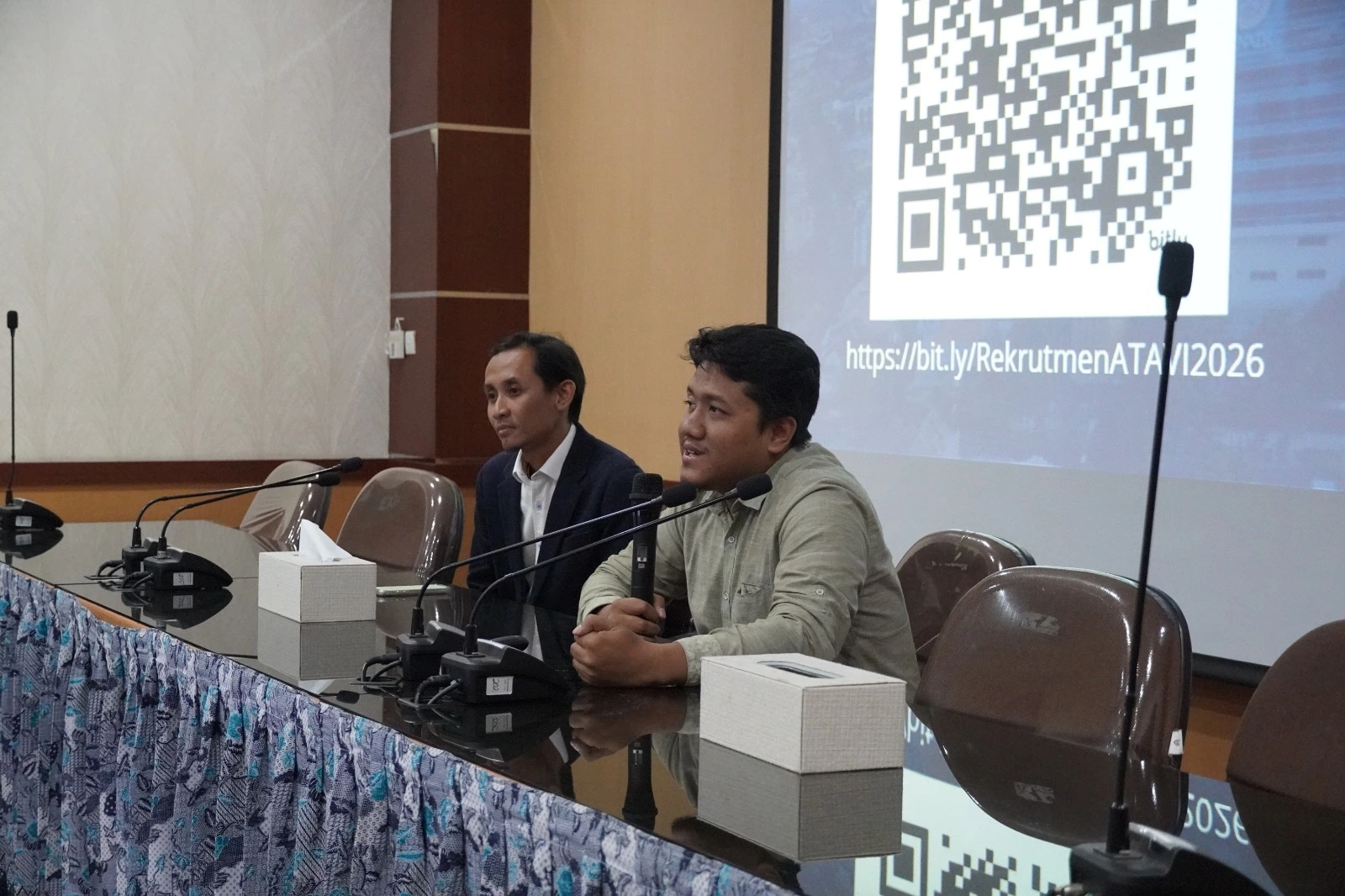
UNAIR NEWS – Efforts to bolster the university’s startup ecosystem continued with the launch of the 2026 business incubation program hosted by Airlangga Startup and Innovation (ATAVI). Organized by the Center for Innovation and Business Acceleration (PASINBIS), the initiative supports Universitas Airlangga (UNAIR)’s ambition to become a World Class Entrepreneurial University. The information session was held Friday (Feb. 13, 2026) in Room 301 of the Kahuripan Building, MERR-C Campus.
The session offered a detailed overview of ATAVI’s incubation framework and formally opened recruitment for startups seeking further development. The program targets students, faculty members, administrative staff and alumni who have already launched early-stage ventures and are looking to expand their businesses.
Advancing research commercialization
Ahmad Fadlur Rahman Bayuny, who leads the ATAVI Business Incubator, said the initiative operates under a direct mandate from the rector. “The incubator is designed to support startup companies founded by students, faculty, staff and alumni. Our objective is to help entrepreneurs within the UNAIR community sustain their businesses and improve their prospects for long-term growth,” Bayuny said.
In addition to nurturing student ventures, ATAVI aims to accelerate the commercialization of faculty research. Bayuny noted that many research findings with strong market potential remain limited to academic publications and have yet to be translated into viable commercial products.
“Much of our faculty research exists only in journals or papers, even though it holds significant potential to become products that benefit the broader public. The incubator serves as a bridge to help move these innovations from research to market,” he said.
ATAVI recruitment process
To qualify, applicants must already have a product and a business that has been operating for at least three months. The selection process includes administrative screening, substantive evaluation and a formal business presentation. “Over the six-month incubation period, selected startups will receive structured training, mentoring, periodic evaluations and targeted assignments to assess both progress and commitment,” Bayuny added.
Beyond mentorship, ATAVI provides access to business boot camps, regional and national business-matching forums, exhibition opportunities and guidance on business licensing and Intellectual Property Rights (IPR) registration. Throughout 2025, ATAVI supported 286 tenant startups, most of them founded by students whose ventures have shown measurable growth.
Importance of legal foundations
The event concluded with a discussion session featuring Dillon Arie Lesmana, founder of Jayanira Coffee Studio and an alumnus whose business has been supported by ATAVI. Dillon shared his experience building a coffee enterprise through the incubator’s guidance.
He stressed the importance of establishing proper legal standing, particularly when partnering with institutions or professional entities. “If we believe our product delivers real value and impact, we must also ensure that our business foundation is strong, including its legal framework,” Lesmana said.
In closing, he encouraged students to continuously sharpen both their technical and interpersonal skills, even if their academic background does not directly align with their business pursuits. “A commitment to learning, the courage to take initiative and consistency are essential to building a business that endures,” he said.
Author: Nur Khovivatul Mukorrobah
Editor: Ragil Kukuh Imanto