


UNAIR NEWS – The name Haruki Murakami is widely recognized among global literature enthusiasts. The Japanese author is known for works that often place protagonists in states of solitude. His distinctive narrative style has influenced writers across Southeast Asia, including Malaysia.
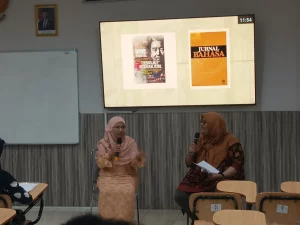
During a guest lecture titled Haruki Murakami from the Perspective of Malaysian Creative Writers, students from the Faculty of Humanities (FIB) Universitas Airlangga examined this literary phenomenon in greater depth. The event was organized by the Japanese Literature Study Program on Tuesday, April 28, 2026, at Herodotus Room A, third floor of the FIB building, Dharmawangsa-B Campus.
In her remarks, Head of the Japanese Language and Literature Program Nunuk Endah Srimulyani PhD emphasized that the lecture aimed to explore Murakami’s writing style through the lens of Malaysian authors. She added that the forum could serve as a starting point for future academic collaboration in literary studies.
“It could become an entry point for further research, for instance from an Asian studies perspective,” she said.
Examining sogai and the relevance of loneliness
Dr. Normalis Amzah explained that a central element in Murakami’s style is sogai, or social alienation. He noted that the loneliness portrayed in Murakami’s works differs from traditional notions of solitude that disappear through social interaction. Instead, sogai reflects a sense of isolation even in crowded environments.
“Typically, Murakami’s protagonists are introverted and tend to act as observers rather than actively engage with others,” he said.
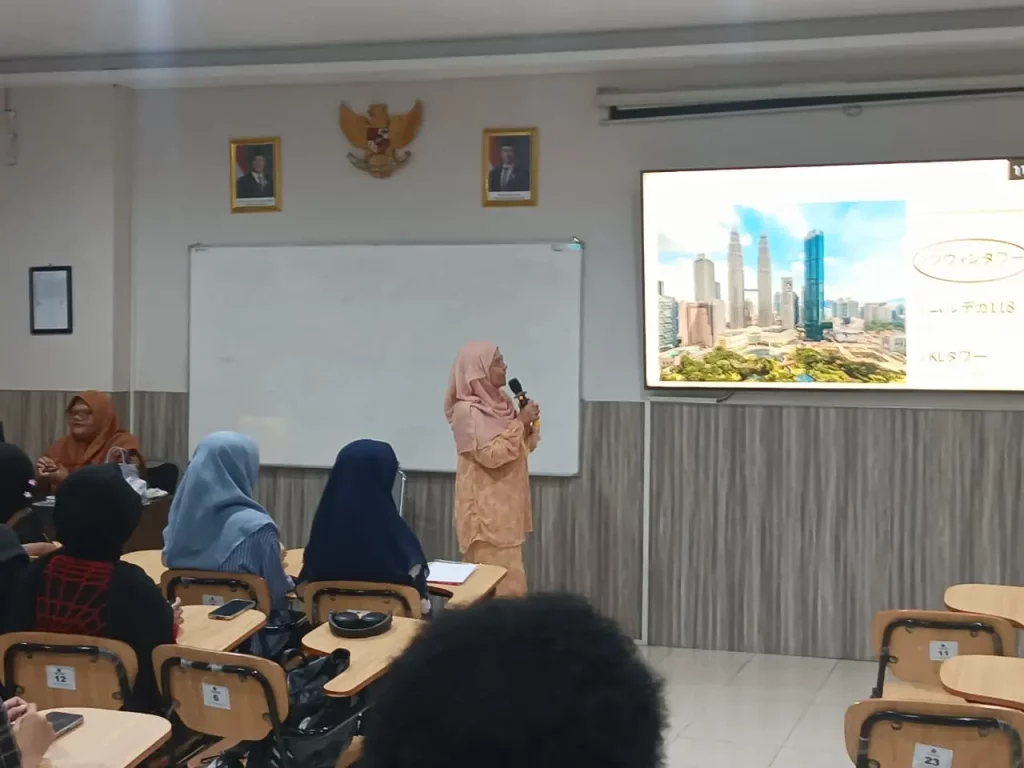
He also connected this concept to the evolution of Malay literature over the past two decades. While earlier works often focused on religious themes and collective society, contemporary Malay literature has shifted toward individualism, exploring inner human experiences more relevant to modern life.
Magical realism and absurdism
Beyond themes of loneliness, Murakami’s works frequently incorporate magical and absurd elements. Illogical occurrences such as talking cats or portals to alternate worlds are presented as ordinary within his narratives. These surreal aspects often serve as manifestations of loss or trauma that cannot be expressed through words.
“This is a defining characteristic of Murakami that inspires Malaysian writers. The solitude of his characters allows readers to connect with those magical and absurd experiences,” said the Universiti Kebangsaan Malaysia academic.
Several Malay literary works have drawn inspiration from Murakami’s style, including Stereo Genmai by Ridwan Saidi. The work features mystery elements and characters trapped within their own thoughts and has gained popularity in Malaysia for its accessible blend of the supernatural and the everyday.
“Murakami’s influence extends beyond Malaysia. It reaches a global audience. Perhaps it is because he does not focus on external realities, but instead explores the inner world of human beings,” he concluded.
Author: Amelia Farah P.I
Editor: Yulia Rohmawati