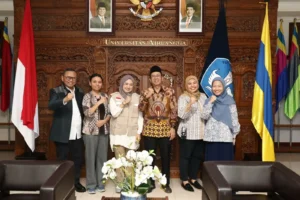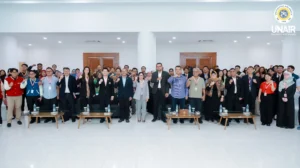


UNAIR NEWS – Universitas Airlangga (UNAIR), through Airlangga Global Engagement (AGE), in collaboration with Indonesia’s Ministry of Foreign Affairs, hosted the D-8 Youth Dialogue under the theme “Navigating Uncertainty, Building Resilience” on Wednesday (June 3, 2026). Held at Majapahit Hall on UNAIR’s MERR-C Campus, the event featured Dr. Rian Diana, S.P., M.Si., a Nutrition expert from the Faculty of Public Health (FKM), and Kamapradipta Isnomo, Special Advisor to the Minister of Foreign Affairs for Social, Cultural, and Community Development Affairs.
Six pillars of food security and role of students
Dr. Rian Diana emphasized that food security is a multidimensional issue that extends beyond agriculture and food consumption. Effective food security policies, she said, require coordinated action across multiple sectors. “When discussing food security, six pillars must be addressed comprehensively: availability, access, utilization, stability, agency, and sustainability,” she explained.
She pointed to a major contradiction within Indonesia’s food system: while the country performs relatively well in ensuring food availability, it remains highly dependent on global markets and insufficiently prepared for climate-related challenges. “Tempeh may be one of Indonesia’s cultural icons, but more than 90 percent of the soybeans used to produce it are imported. We have demonstrated strong performance in food availability and resilience during crises, yet significant gaps remain in sustainability and climate adaptation,” she said.
To address these challenges, Dr. Diana encouraged UNAIR students from diverse academic backgrounds to contribute solutions through their respective fields of expertise. She stressed that structural food-system issues require interdisciplinary approaches. “Students in agriculture, communication, and engineering can all play a role in solving systemic challenges, including helping farmers become more financially viable. When meat prices rise, communication students can also help educate communities about alternative protein sources such as eggs and chicken, which provide comparable nutritional value when supported by proper nutrition literacy,” she said.
She added that supporting environmental sustainability does not always require sweeping policy reforms. Instead, meaningful contributions can begin with everyday actions. “The agency and sustainability pillars are actually very simple. Finish your food and clear your plate, because food waste remains one of the largest contributors to greenhouse gas emissions,” she said.
Diplomacy and D-8 Halal Ecosystem
Kamapradipta Isnomo expanded the discussion by highlighting the importance of national food self-reliance in an era of growing global protectionism. Reflecting on lessons from the COVID-19 pandemic, he noted that countries tend to prioritize domestic needs when crises occur. “During periods of crisis, nations inevitably focus on their own populations, as we witnessed during the distribution of COVID-19 vaccines. Food is no longer merely about feeding people, it is also about safeguarding stability, dignity, and collective prosperity,” he said.
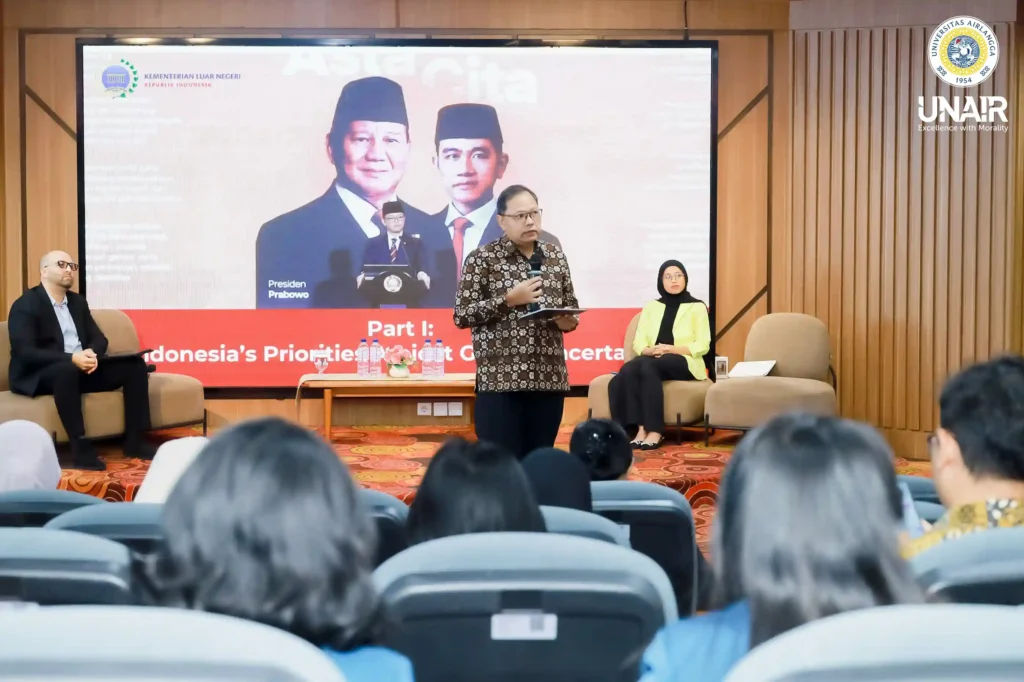
He also advocated for deeper economic cooperation among D-8 member states, a bloc of eight developing countries with predominantly Muslim populations. With a combined market of approximately 1.3 billion people, he said, the group is well positioned to capitalize on opportunities within the global halal industry. “The D-8’s greatest strength lies in its halal ecosystem. Halal is no longer solely a religious consideration; it has become a symbol of safety, quality, and consumer trust that can generate substantial economic benefits, particularly for small and medium-sized enterprises,” he said.
In his closing remarks, Kamapradipta Isnomo encouraged UNAIR students to take an active role in advancing economic diplomacy. “The future of global food security will be shaped by young people. Through forums and collaborations like this, we hope UNAIR students will develop digital innovations and entrepreneurial initiatives capable of making our halal ecosystem more competitive on the international stage,” he said.
Author: Muhammad Yasir Dharmawan Diniy
Editor: Yulia Rohmawati