

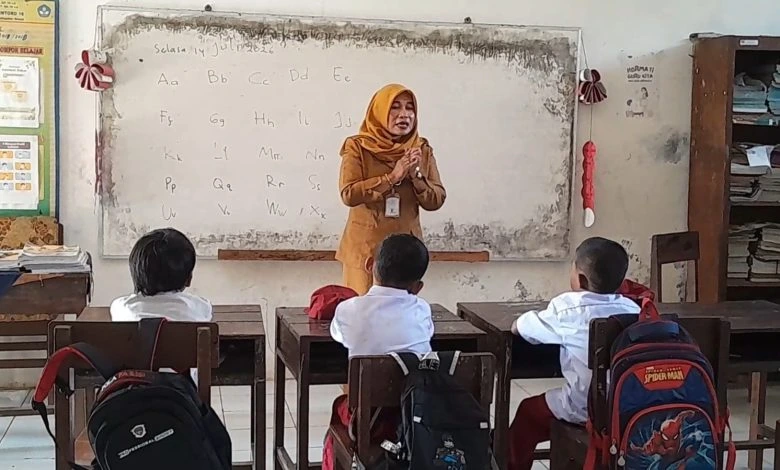
UNAIR NEWS – Classrooms at a public elementary school (SDN) in Demak Regency, Central Java, recently drew public attention after enrolling only three new students for the current academic year. The phenomenon also reflects deeperg the changing landscape of education in Indonesia.
Responding to the issue, Rafi Aufa Mawardi SSosio MSosio, a lecturer in the Department of Sociology, Faculty of Social and Political Sciences (FISIP), Universitas Airlangga (UNAIR), shared his perspective. He argued that the situation reflects a shift in parents’ perspectives and priorities when choosing educational institutions.

Rethinking the meaning of school
Mawardi explained that in the past, parents primarily prioritised access to education so their children could attend school. Today, however, their priorities have shifted towards the quality of education, the social environment, moral values, and a school’s reputation. According to Mawardi, faith-based private schools, such as Integrated Islamic Elementary Schools (SDIT) and madrasahs, have become particularly attractive because they place strong emphasis on moral development during early childhood.
“In the past, the main concern was simply ensuring that children could attend school. Today, however, the priority is ensuring they receive a quality education. Parents no longer consider accessibility alone; they also pay close attention to more fundamental factors, such as the school’s social environment, moral values, and reputation,” Mawardi said.
Education as an investment and the changing dynamics of school catchment areas
From a sociological perspective, Mawardi related the phenomenon to Pierre Bourdieu’s theory of social practice. He argued that parents’ decisions to enrol their children in fee-paying schools reflect a long-term social investment that combines economic, social, and cultural capital with religious and moral values.
“More expensive fee-paying schools are often viewed as a long-term social investment that integrates religious and moral values with economic, social, and cultural capital,” Mawardi explained.
In addition to changing societal values, Mawardi also highlighted the effectiveness of the school catchment area system and demographic dynamics. Although the policy is intended to promote equitable access to education and reduce disparities between so-called “elite” and other schools, its implementation has often encountered technical challenges. One of the most significant is the mismatch between the number of schools and the population of school-age children in certain areas, a situation further exacerbated by declining birth rates.
“When birth rates decline and there are too few children of elementary school age in a particular area, the school catchment area policy can ultimately become a trap. It leaves some schools with fewer applicants because it fails to account for the relationship between the number of schools and the size of the student population,” Mawardi said.
The dilemma of three-student classrooms and proposals for school mergers
Regarding classrooms with only three students, Mawardi argued that such a situation is far from ideal. While smaller class sizes may allow for more focused and personalised learning, the limited number of students reduces children’s opportunities to build friendships and develop social interaction. He also cautioned against pursuing school mergers solely on the grounds of economic efficiency.
“Mergers may be efficient in the context of economic institutions such as companies, but schools cannot be treated in the same way. If the government intends to pursue school mergers, it must first undertake a more comprehensive assessment of issues such as accessibility, transportation, and the potential impact on community identity,” Mawardi concluded.
Author: Fauziah Laili Romadhon
Editor: Ragil Kukuh Imanto