

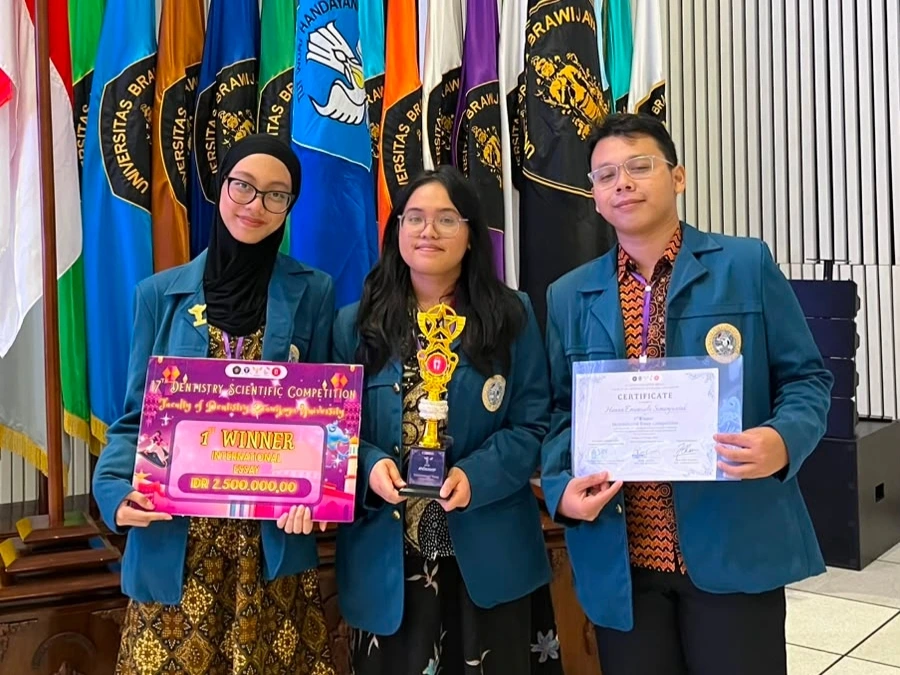
UNAIR NEWS – An innovation based on 3D bioprinting technology has earned students from the Faculty of Dental Medicine (FKG), Universitas Airlangga (UNAIR), first prize in the International Essay Competition category at the 17th Dentistry Scientific Competition (DSE) 2026. The competition was held on Saturday (1/8/2026) at the Faculty of Dentistry, Universitas Brawijaya
The team consisted of Hanna Emanuela Simanjuntak, Dyandra Aulia Daanisy, and Zaki Septiyono Saputra. They presented an essay entitled PIONEER: A Bioactive PLA/nHA/Naringin Scaffold to Promote Osteogenic Differentiation of Human Dental Pulp Stem Cells, which proposes a 3D bioprinting-based bioactive scaffold designed to support dental pulp tissue regeneration
Dental pulp regeneration through 3D bioprinting
Hanna Emanuela Simanjuntak explained that the innovation was inspired by the challenge of treating pulp necrosis in immature permanent teeth with incomplete root development. According to Hanna, conventional endodontic treatment primarily focuses on eliminating infection and has yet to fully restore the function of dental pulp tissue.
“We developed the concept of a bioactive scaffold that combines polylactic acid (PLA), nano-hydroxyapatite (nHA), and naringin (NAR). The scaffold is fabricated using 3D bioprinting technology to support dental pulp tissue regeneration, while its design is customized to each patient’s root canal anatomy based on cone beam computed tomography (CBCT) imaging,” Simanjuntak explained.
Saputra added that PLA serves as the structural framework for cell growth, while nHA provides properties that support the formation of new tissue. Naringin, meanwhile, was selected for its anti-inflammatory, antioxidant, and antibacterial properties, as well as its ability to naturally promote bone regeneration.
“Unlike conventional scaffolds, which generally focus solely on tissue regeneration, this combination of bioactive materials also has the potential to inhibit infection while promoting the formation of new blood vessels during the healing process,” Saputra said
Potential for further development through future research
Daanisy explained that the innovation is currently a conceptual framework developed from scientific literature and therefore requires further experimental validation. Nevertheless, Daanisy hopes the concept can serve as a foundation for developing more precise regenerative endodontic therapies in the future.
In a closing statement, the team encouraged fellow students to take part in competitions and step outside their comfort zones. “Read extensively, understand the issue you want to address, and don’t be afraid to propose new solutions. That is where ideas that can truly benefit society begin,” they concluded.
Author: Maulya Afifah Zahra
Editor : Khefti Al Mawalia