

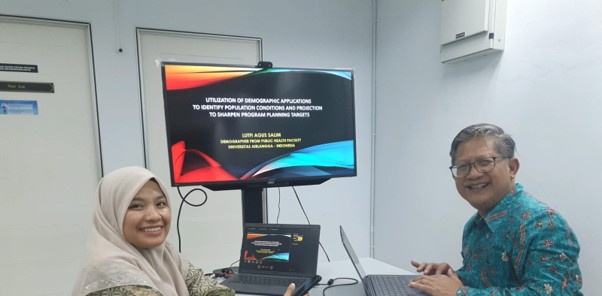
UNAIR NEWS – Academic collaboration between Universitas Airlangga (UNAIR) and Universiti Kebangsaan Malaysia (UKM) continued through the International Journal Club, held in a hybrid format on Friday (August 14, 2026). During the event, which ran from 10 AM to 11 AM Malaysian time, Prof Lutfi Agus Salim from UNAIR had the opportunity to share his experiences and insights in the fields of demography and public health with members of the academic community at UKM. The event was co-organized with the Faculty of Health Sciences, Universiti Kebangsaan Malaysia, and the Center for Healthy Ageing and Wellness (H-Care), which houses research and academic activities in healthy aging and well-being.
“We hope the discussion won’t stop at this one forum. There are many possibilities we can develop together, from research and guest lectures to publications. Most importantly, we can identify common ground that serves our shared interests and produces meaningful outcomes,” Prof Salim said.
Understanding population conditions
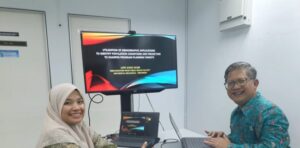
During the forum, Prof Salim presented a paper titled “Utilization of Applications to Identify Population Conditions and Projections to Sharpen Program Planning Targets.” The presentation highlighted the importance of using apps and demographic data to understand population conditions and produce more accurate projections, allowing health program planning to better align with community needs.
During the forum, Prof Salim presented a paper titled “Utilization of Applications to Identify Population Conditions and Projections to Sharpen Program Planning Targets.” The presentation highlighted the importance of using apps and demographic data to understand population conditions and produce more accurate projections, allowing health program planning to better align with community needs.
“Demographic data is not only important for understanding population size, but also for understanding how the population is changing and what it may look like in the future. With the right use of applications and projections, program planning can become more focused and better aligned with community needs,” Prof Salim said during the discussion session.
According to Prof Salim, the use of data and technology becomes increasingly important as public health issues grow more complex. Information on population characteristics, shifts in age structure, and population projections can serve as a basis for determining intervention priorities and allocating resources more effectively. He noted that a data-driven approach must continue to be strengthened through collaboration among researchers and institutions.
A positive reception
The presentation received a positive response from Dr Sumaiyah Mat, a researcher at the Center for Healthy Ageing and Wellness (H-Care), Faculty of Health Sciences, Universiti Kebangsaan Malaysia, who also serves as Head of the Postgraduate Research Program at H-Care. Her research focuses on falls and musculoskeletal issues among older adults.
“This kind of discussion opens up opportunities to view health issues from a broader perspective. A demographic approach and the use of population data are highly relevant to supporting health program planning, including when it comes to an aging population and future health needs,” Dr Mat said during the discussion.
Dr Mat also welcomed the opportunity to bring together perspectives from Indonesian and Malaysian researchers. She noted that the experience and expertise of both institutions could serve as a foundation for developing a more specific and impactful collaborative research agenda. The meeting served not only as a forum for sharing insights, but also as an initial discussion on academic collaboration opportunities between UNAIR and UKM. Going forward, both institutions are expected to develop joint research projects, guest lectures, scientific publications, researcher and student exchanges, and other academic activities that bring together their respective expertise.
“We hope this relationship can continue in the form of more concrete collaboration. If we find suitable research topics, we can develop proposals together, exchange knowledge, and produce joint publications,” Dr Mat said.
For UNAIR, the opportunity to present at UKM was also part of a broader effort to strengthen its international network and advance evidence-based public health research. The exchange of perspectives between researchers from the two countries can help enrich research approaches, particularly in understanding population change and its implications for health needs.
This event also carries a strong connection to the Sustainable Development Goals (SDGs), particularly SDG 3: Good Health and Well-being, through strengthening health program planning based on population needs; SDG 4: Quality Education, through the exchange of knowledge and learning across countries; and SDG 17: Partnerships for the Goals, through building research partnerships between UNAIR and UKM.
For Prof Salim, international collaboration is not just about expanding networks, but also about generating knowledge that can address real-world issues. “We hope the partnership between UNAIR and UKM can grow from a sharing activity into a collaboration that produces research and publications, while remaining oriented toward benefiting the public,” he said.
Through the International Journal Club, the academic relationship between UNAIR and UKM is expected to open up further for a wider range of collaborative initiatives. From discussions on data and demographics to health program planning, both institutions have significant room to develop research relevant to health challenges in Indonesia, Malaysia, and Southeast Asia region.
Author: Bian Shabri Putri Irwanto
Editor: Yulia Rohmawati