

UNAIR NEWS – Universitas Airlangga (UNAIR) developed Total Knee Arthroplasty (TKA) implant to provide the needs of knee implants that suit the characteristics of Asian populations. This development was the output of the collaboration between Faculty of Medicine (FK), Faculty of Veterinary Medicine (FKH), and Faculty of Science and Technology (FST).
Currently, this development has entered the in vivo preclinical testing phase, which is being conducted at UNAIR Veterinary Hospital (RSH), MERR-C Campus. In this development, UNAIR is also collaborating with an industry partner, PT Trafas Dwi Medika, represented by Septian Indra Wicaksana.
The issue of whether the TKA product in the market is suitable with the anatomy of Asian populations has become the background for the development of knee implants. An FST UNAIR lecturer, Prof Dr Prihartini Widiyanti drg MKes SBio CCD, explained that the design for these implants is based on the anthropometric data and the anatomy of the knees of Asian populations. The asymmetrical shape of the joint and the need for activities requiring a high degree of flexion were the key considerations for this development.
“This design is tailored to the anatomy of Asian people and the need for activities requiring a high degree of flexion. For example, the movements during prayer and certain sitting positions,” she explained.
Develop anatomy-based design
Furthermore, Prof Widiyanti said that the research process has been underway since 2024. After finishing the design in 2025, the team selected 68 candidate materials in silico using Technique for Order Preference by Similarity to Ideal Solution (TOPSIS) method.
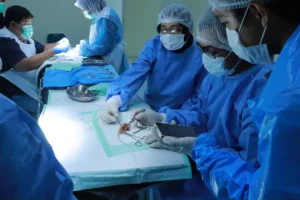
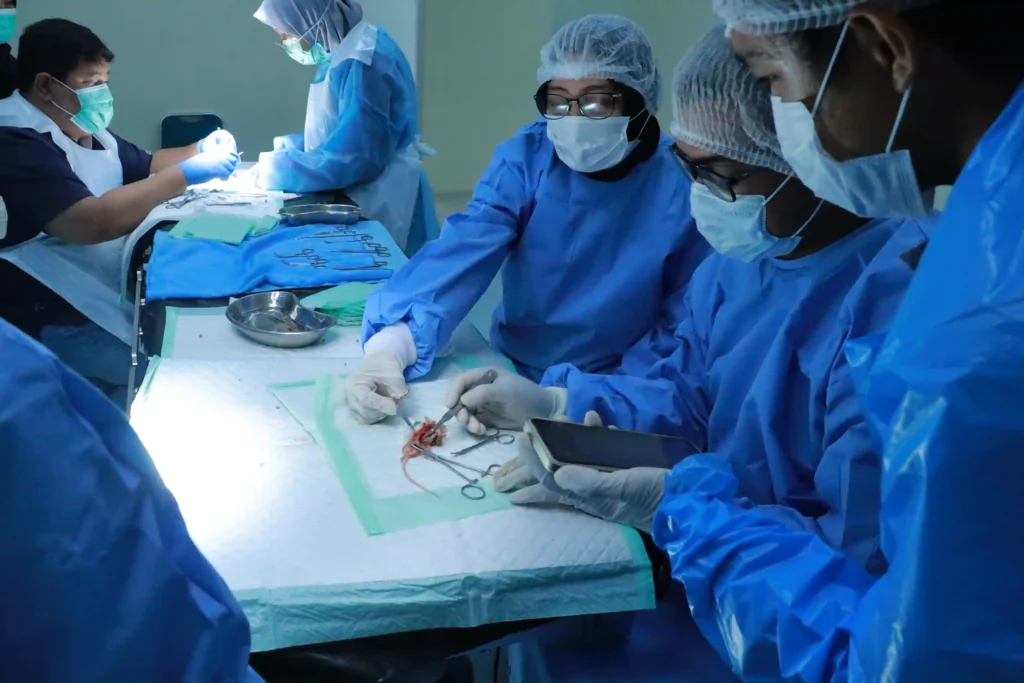
The selection process resulted in three candidate materials for in vitro testing using cells and mechanical testing. These materials originated from France, China, and Germany. These selected materials then underwent in vivo testing at UNAIR Veterinary Hospital. After 40 days of implantation, the team collected samples of bone tissue, blood, and organs on Tuesday, September 1, 2026. These samples were used to analyze osseointegration, biocompatibility, immunological response, hematology, and toxicity.
Muhammad Hafizh Athari ST MT, a graduate of the Magister’s program in Biomedical Engineering at UNAIR who contributed to the TKA development, explained that the testing process was conducted to determine the body’s response to the biomaterial.
“We conduct these tests to determine the body’s response to biomaterial. Ranging from osseointegration and biocompatibility to immunological responses and toxicity. All tests are conducted in accordance with ISO standards,” he explained.
Inter-disciplinary collaboration toward downstreaming
In this collaboration, FK UNAIR contributes to the clinical aspects and orthopedic needs, while the Biomedical Engineering department of FST UNAIR focuses on the design and biomaterial, and Veterinary Hospital FKH UNAIR supports pra-clinical testing. PT Trafas Dwi Medika is responsible for production, component fabrication, material procurement, and product regulation and registration.
Preliminary test results show a response in line with the team’s expectation. The implant design has also been patented. Once finishing the analysis and report, the team plans to continue development toward further downstreaming and production.
This innovation is expected to produce implants tailored to the characteristics of Asian patients while reducing reliance on imported products. Collaboration among academics, medical professionals, teaching hospitals, and industry is a crucial step in ensuring that UNAIR’s research findings can benefit the public.
Author: Abraham Chrisanta Putra
Editor: Yulia Rohmawati