
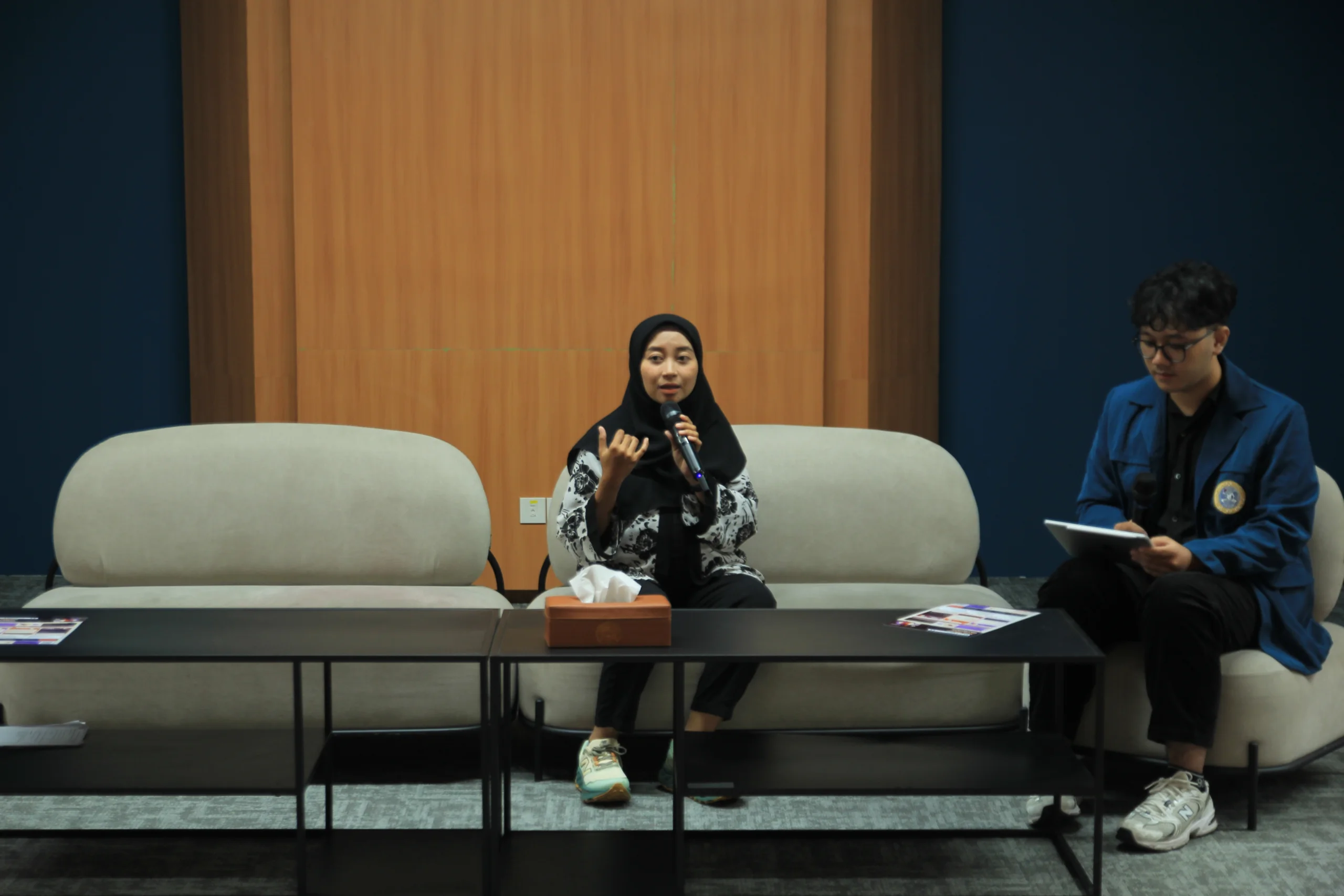
UNAIR NEWS – The 18,000 Dollar Team (Tim Dolar 18 Ribu) of Universitas Airlangga (UNAIR) held a screening and discussion of Pratibimba on Friday, October 16, 2026. The event took place at Bima Suci Hall, Airlangga Convention Center (ACC). It was both a step on the team journey and a proof of its readiness for the finals of the 2026 Student Digital Innovation Competition (LIDM).
This team consists of Haqi Nuha Ahnafy (Faculty of Veterinary Medicine), Muhammad Fatih Rabbani (Faculty of Veterinary Medicine), Emanuel Yudhistira (Faculty Fisheries and Marine), and Marsha Nurrahmadina Muntahir (Faculty of Social and Political Sciences). The event featured Dr Sukma Rahastri Kanthi SPsi MPsi, Psychologist, as a guest speaker. She analyzed Pratibimba through three lenses: digital mirroring, the projection of appearance-related insecurities, and desensitization to comments.
Between the real self and the on-stage self
Dr Kanthi explained that the digital world has its own unique appeal. “In the digital world, we’re given the power to express ourselves exactly as we envision. This makes social media so much fun,” she said.
Problems arise when the gap between reality and ideal self is too wide. This creates an unhealthy relationship between ourselves and our behavior. As a result, a person always feels inadequate.
“We can present ourselves, but remember not to stray too far from our true selves. Understand your strengths and weaknesses, then present them in a positive light,” she emphasized.
She noted that people naturally enjoy receiving feedback. “People feel that what they show on social media is their true self, so negative comments are often taken as fact.”
Be honest, pause, protect: Safeguarding yourself and others
Dr Kanthi explained why it feels easier to hurt others. This happens because anonymity makes people feel free to respond however they want. Distance also makes it difficult for someone to gauge others’ reactions to their comments.
“In communication, 80 percent of our judgments come from nonverbal cues. On social media, we can’t see the content creators’ responses, so we write whatever we want,” she said.
She then distinguished between criticism and hate speech. Criticism targets behavior or ideas that have a basis in fact. Hate speech attacks physical traits and character traits that cannot be changed.
“If the goal is to vent emotions and belittle others, it should be stopped,” she asserted.
As a guideline, she raised a principle that Pratibimba also advocates. “Be honest, ask yourself what your purpose is in commenting. Pause, think about the impact. Be mindful, respect other people’s feelings, because in real life we also want to be respected,” she explained.
To take care of oneself, Sukma advised people to stop judging themselves when they receive criticism from others. “Set firm digital boundaries, take a digital detox, and filter the information we consume,” she added.
Author: Qurrota A’yuni Latifa
Editor: Khefti Al Mawalia