

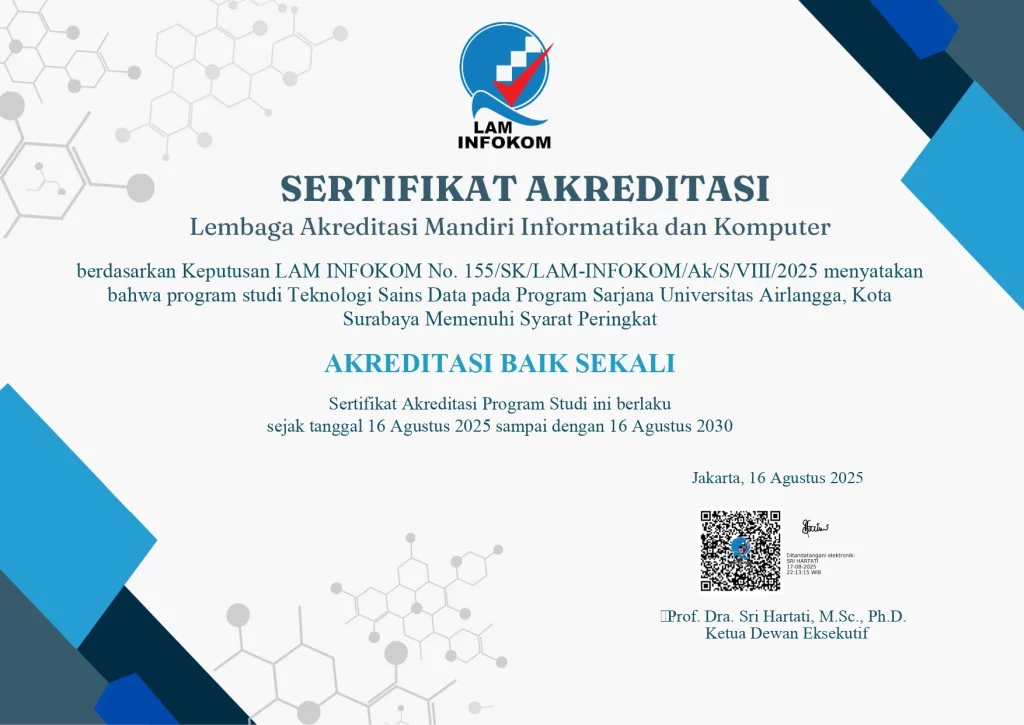
UNAIR NEWS – The Independent Accreditation Board for Informatics and Computing (LAM INFOKOM) has announced the results of its field assessment for two study programs under Universitas Airlangga’s Faculty of Advanced Technology and Multidiscipline (FTMM). The programs—Data Science and Technology (TSD) and Robotics and Artificial Intelligence Engineering (TRKB)—earned a “Very Good” accreditation rating, effective from Saturday, August 16, 2025, for a period of five years.
Stronger accreditation standing
The “Very Good” rating marks an improvement from the programs’ previous accreditation status. It also follows the 2022 evaluation by the National Accreditation Board for Higher Education (BAN-PT), which granted both programs a “Good” rating.
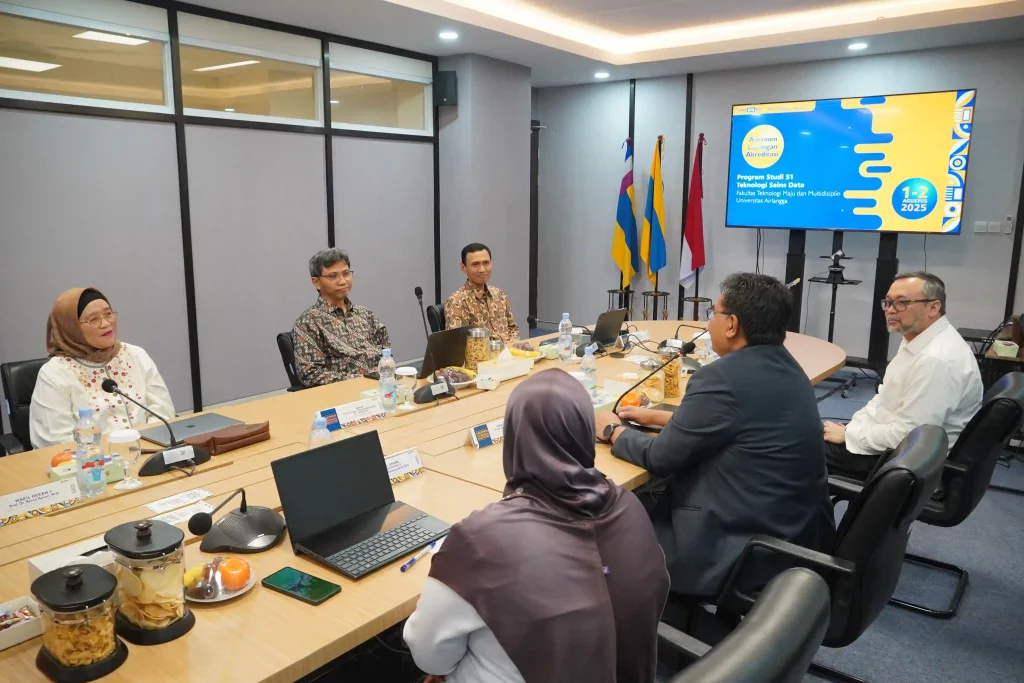
Before the announcement, both programs underwent field assessments: TRKB on July 18–19, 2025, and TSD on August 1–2, 2025, at the Nano Building, MERR-C Campus. Following the process, TRKB Program Coordinator Purbandini awaited the official results from LAM INFOKOM. Although the upgraded status was welcomed, she stressed that the findings would also serve as a reference for ongoing internal improvements.
Recommendations for advancement
LAM INFOKOM assessors provided several recommendations to help TRKB and TSD further enhance their performance. Among them were key points under Criterion Six, which covers education and teaching.
Under this criterion, assessors advised ensuring structured reviews of internationally recognized journal articles. Such reviews could serve as a foundation for faculty and student research, supporting both scientific development and academic assessment in courses aligned with program competencies. Assessors also encouraged replacing certain simulation-based classes with training that uses actual equipment.
Further input was given under Criterion Seven, related to research. Assessors recommended increasing interdisciplinary and cross-institutional projects, while also ensuring that research initiatives deliver tangible benefits to society.
Author: Ahza Riga Falimbani
Editor: Yulia Rohmawati