

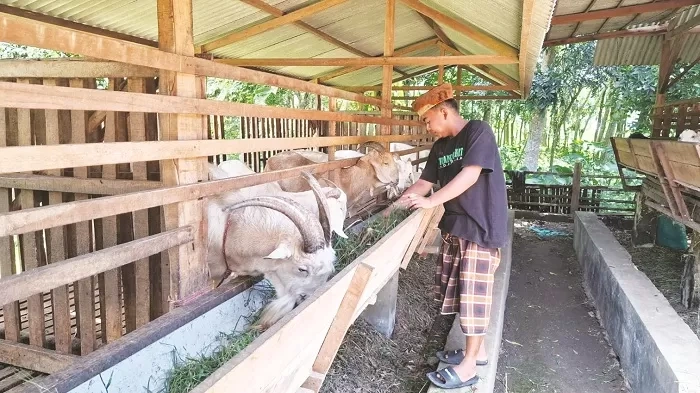
The Pote goat is an unclumped indigenous Indonesian goat native to Bangkalan, Madura. Genetic selection may be utilized to acquire Pote goat varieties as germplasms in order to increase genetic diversity. The Pote goat, residing in Bangkalan, East Java, is categorized as either a small or large variety of indigenous Indonesian goats according to the shoulder height and body weight of mature female goats, respectively. As age progressed, body weight and size increased. The dominant qualitative characteristics of the subject are its white body color, convex facial profile, drooping and widened ears that are relatively short in size, straight right and left horns, rewound fur, absence of papillae, and jug-shaped udder.
In the lowland region of Madura Island, the Pote goat population is characterized by the following proportions: 34.83% males and 65.17% females. The male-to-female ratio among adults is 1:12.20. Annually, the percentage of goat offspring who died was 8.08% (males 2.31%, females 5.77%). Among goats of varying ages, a mortality rate of 9.34% was recorded (males 2.77% and females 6.57%). As the age of the doe increases, the average litter size rises from 1.76±0.54 to 1.98±0.47 head per birth. The birth categories comprised the following: triplet births (10.39%), quadruplet births (1.43%), twin births (73.48%), and single births (14.70%).
Foot and mouth disease (FMD) continues to be a significant animal health concern in the majority of Southeast Asia (SEA), where it is endemic. Madura Island was afflicted with FMD between 1906 and 1913. In Indonesia, hundreds of thousands of livestock have been re-infected with foot and mouth disease following a 32-year FMD-free streak that began in 1990. FMD is an extremely transmissible animal disease that impacts various species with cloven hoofs, including cattle, buffaloes, sheep, goats, piglets, deer, camels, and elephants. As of November 18, 2022, FMD remains prevalent in 146 regencies/cities across 17 provinces, affecting 578,060 heads of infected cows, 508,494 heads of recovered cows, 13,177 heads of conditionally cut cows, 10,269 heads of deceased cows, and 5,847,113 heads of vaccinated cows.
FMD virus infection in goats is characterized by lesions of the soles and buccal mucosa. Vesicles and bullae develop swiftly on the snout, nostrils, lips, and tongue within the oral cavity. As a consequence, a decrease in appetite ensued, which in turn led to a reduction in dietary consumption. Carbohydrate, lipid, protein, mineral, and vitamin deficiency is deleterious to the physiological well-being and reproductive capabilities of animals. Nevertheless, there is a lack of research examining the impact of a combination of macro and micro minerals on the reproductive performance of Pote goats following an infected of FMD. Consequently, the objective of this research endeavor was to ascertain the impact of supplementing concentrate and mineral feed on the reproductive performance of female Pote goats subsequent to infection with FMD.
Penelitian ini merupakan penelitian kolaborasi multi pihak, yaitu dosen Fakultas Kedokteran Hewan Universitas Airlangga (Prof. Dr. Suherni Susilowati, drh., M.Kes., Prof. Dr. Mirni Lamid, drh., MP., Prof. Dr. Imam Mustofa drh., M.Kes., Dr. Zulfi Nur Amrina Rosyada, S.Pt., M.Sc., Prof. Dr. Herry Agoes Hermadi, drh., M.Si), Fakultas Peternakan Universitas Gadjah Mada (Prof. Dr. Ali Agus, ), Badan Riset dan Inovasi Nasional (Aswin Rafif Khairullah, Riza Zainuddin Ahmad), Dokter Hewan Pusat Kesehatan Hewan Galis, Bangkalan, Madura (Chandra Brahmantya), Pakar dari Department of Agriculture and Industrial Technology, Babcock University, Ilishan-Remo, Ogun State, Nigeria (Dr. Adeyinka Oye Akintunde, Bv.Sc., M.Sc., Ph.D.), Pakar Genetika Ternak dari Palestina (Dr. Mutasem Abuzahra, B.Sc., M.Sc), dan Dosen Fakultas Kedokteran Hewan Universitas Syiah Kuala, Banda Aceh (Dr. Siti Rani Ayuti, drh., M.Sc).
In conclusion, this study investigated the impact of mineral and feed supplementation on the reproductive performance of female Pote goats post-FMD infection. While supplementation didn’t significantly increase body weight, it positively affected reproductive parameters like estrus rates and ovarian activity. Supplemented groups showed improved metabolic health markers. Despite the lack of significant weight gain, the study underscores the potential of supplementation in enhancing goat reproductive performance (follicle development and estrus rate) after FMD. Further research is needed to validate these findings across different animal species and environments, aiding in improved reproductive and health management strategies.
Author: Imam Mustofa