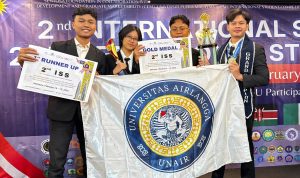


UNAIR NEWS – Students from Universitas Airlangga (UNAIR) have once again demonstrated excellence on the global stage. At the Global Youth Competition (GYC) 2025, organized by the Faculty of Education at Universitas Negeri Surabaya (UNESA), UNAIR’s team claimed second place in the scientific article category. The event brought together students from around the world to present creative ideas and solutions to global challenges in education, environment, and technology.
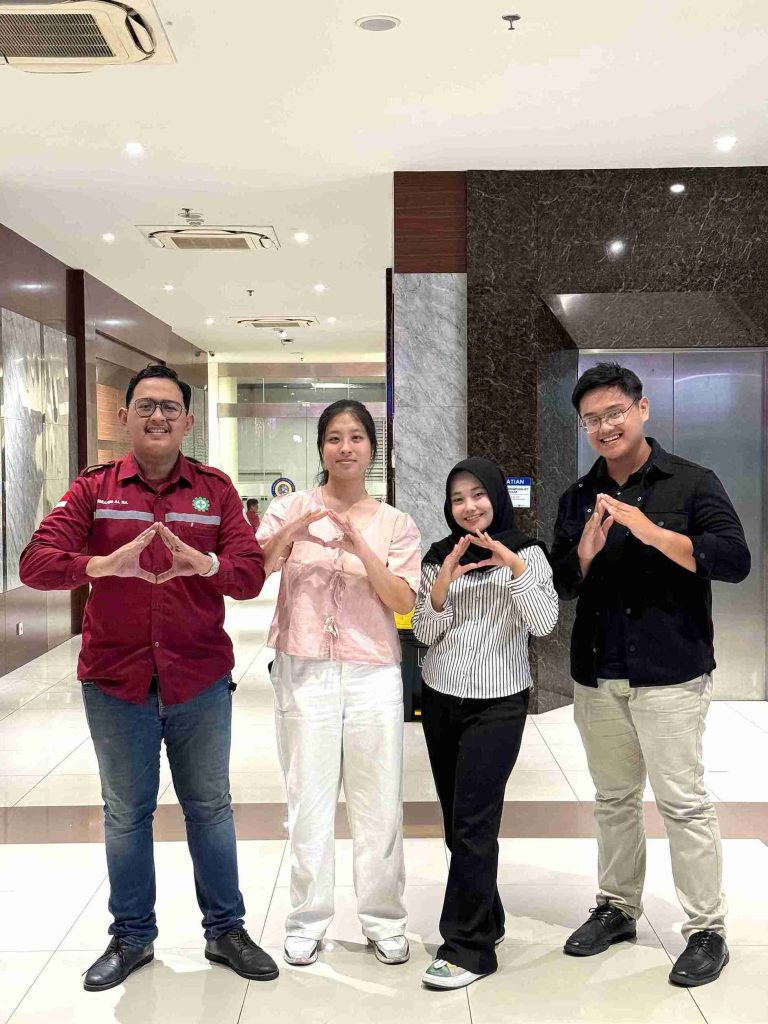
The UNAIR team consisted of Ibrahim Al Khowwas (Faculty of Vocational Studies), Farhan Aldan Khairian (Faculty of Science and Technology), Aleind Aloysius Gonzaga (Faculty of Advanced Technology and Multidiscipline), and Safina Natasya Ul Aulia (Faculty of Pharmacy).
“We chose the scientific article category to showcase research with strong empirical foundations and real potential to contribute to educational advancement,” explained Ibrahim Al Khowwas.
Innovative steps
The team’s journey to success was a long and rigorous one, involving proposal selection, academic paper review, and a final presentation before the judges. Their article, titled “The Effectiveness of Developing AI-Integrated Learning Media Based on Interest-Based Learning,” explored how artificial intelligence can enhance student engagement.
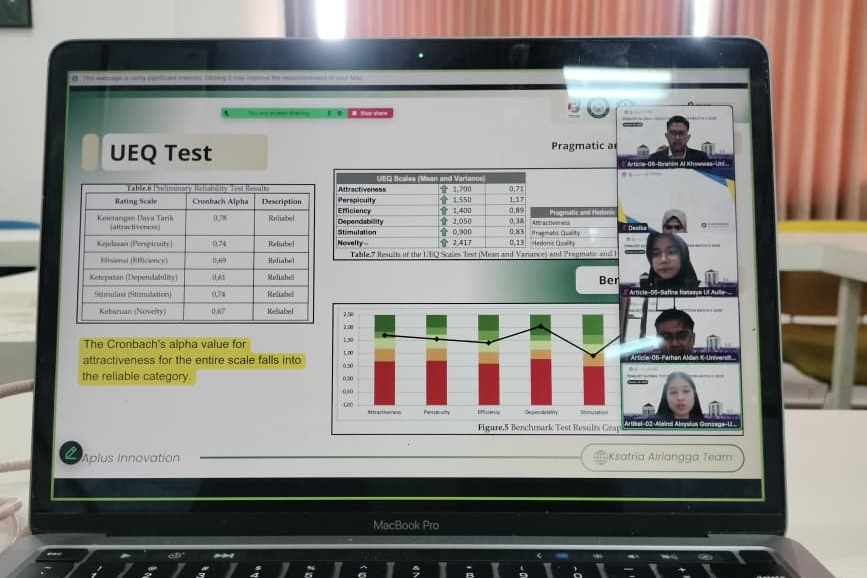
Their project introduced Aplus, an AI-powered digital learning platform designed to personalize content according to students’ interests by using familiar characters like Doraemon, Boboiboy, and Naruto.
The research applied a Research and Development (R&D) method using the ADDIE framework: Analysis, Design, Development, Implementation, and Evaluation. Before drafting the paper, the team conducted field observations, pre- and post-tests, and statistical analysis using R software. The findings indicated that the AI-based platform significantly improved both learning motivation and academic performance among elementary school students. “We chose this topic after observing low motivation among elementary students caused by traditional learning media that fail to capture their interest,” Al Khowwas shared.
Judges’ recognition
Although the team achieved remarkable success, they also faced challenges, particularly in managing their schedules amid academic demands.
“The final presentation before international judges was both tense and invaluable. We were thrilled when they praised our integration of AI and children’s learning psychology. It reaffirmed that our research direction aligns with the future of education,” he added.
Following their win, the team plans to develop Aplus into a mobile-based learning app for elementary schools and publish their research in a reputable international journal.
Author: Adinda Octavia Setiowati
Editor: Yulia Rohmawat