



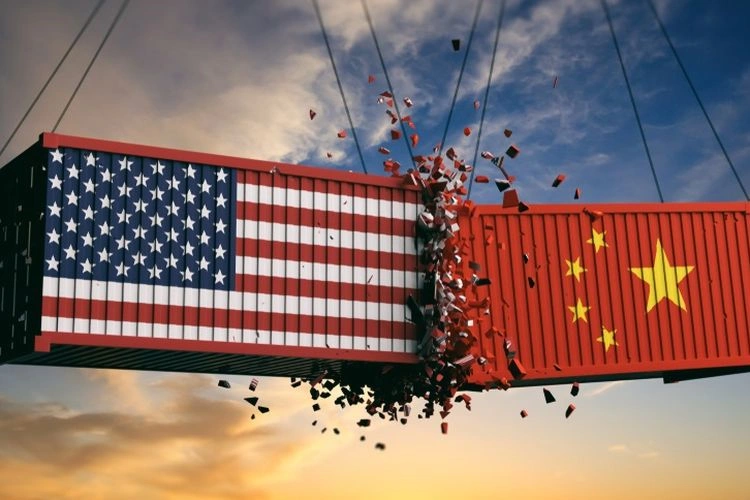
Global economic uncertainty is increasing due to geopolitical factors, changes, and adjustments in monetary policy by countries with the largest economies in the world. The trade war between the United States (US) and China has escalated in recent years, causing US policy propaganda to disrupt various countries’ political and economic stability worldwide. Indonesia’s financial and trade stability is significantly impacted by increasing global economic uncertainty caused by geopolitical dynamics and changes in monetary policy in major economies. The Vector Error Correction Model with Exogenous Variables (VECM-X) approach can investigate the relationship between the volatility of Indonesia’s financial and trade indicators and global economic uncertainty.
Based on a study using monthly data from January 2019 to December 2024, this model considers external factors including the US Dollar Index (DXY), the Volatility Index (VIX), and Trade Policy Uncertainty (TPU). The analysis found a cointegration relationship between the Rupiah exchange rate (USD/IDR), interest rates, exports, imports, and the Jakarta Composite Index (JCI), and that each variable exhibits unique volatility with a fluctuating pattern. Although there is a unidirectional relationship between exports and imports, the Jakarta Composite Index (JCI), and the exchange rate, the causality test results indicate that imports, exports, and the JCI all have an impact on interest rates without a reciprocal relationship.
Furthermore, there is a reciprocal relationship between imports and the Jakarta Composite Index (JCI), which influence each other. The Impulse Response Function (IRF) results indicate that endogenous factors interact dynamically in the short term before progressively stabilizing in the medium to long term. Furthermore, the variance decomposition results indicate that, in the short term, the variability of each variable is primarily explained by itself, with the contribution of other variables growing over time.
This study helps improve Indonesia’s macroeconomic resilience, which advances Sustainable Development Goal (SDG) 8: Decent Work and Economic Growth. More in-depth insights into how domestic stability is affected by global shocks can be obtained by incorporating exogenous global variables into the VECM-X model. However, this study does not account for sectoral or microeconomic variance and is limited to macro-level analysis using secondary data.
Author: Dita Amelia, S.Si., M.Si.
Details of the research can be viewed here