



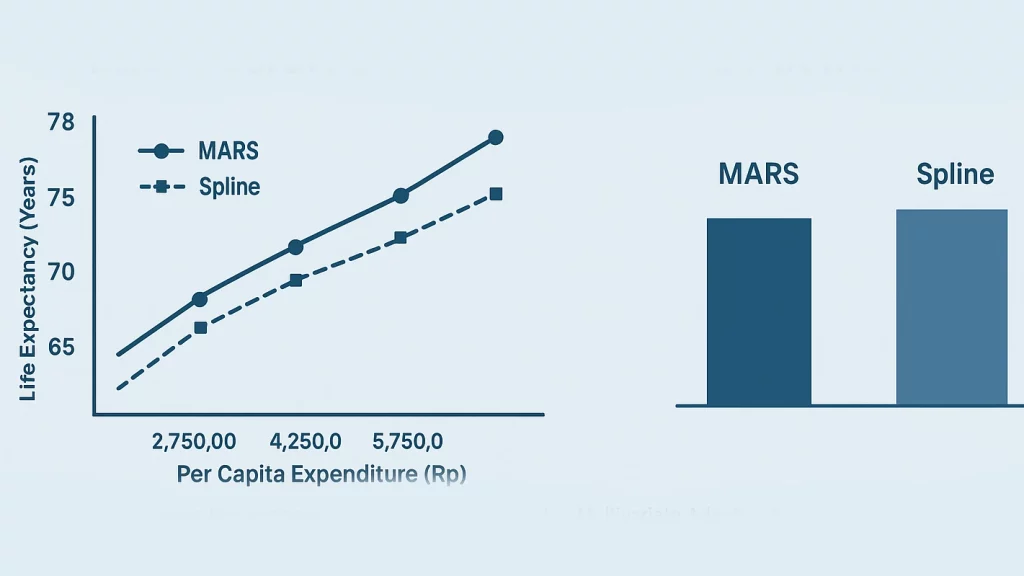
This study investigates life expectancy in Indonesia by comparing two nonparametric regression methods: Multivariate Adaptive Regression Spline (MARS) and Spline Nonparametric Regression, using 2023 data from 34 provinces provided by the Indonesian Central Bureau of Statistics (BPS). Life expectancy serves as a critical indicator of public health and overall welfare, influenced by various socioeconomic factors. The variables analyzed include access to decent housing, access to clean drinking water, per capita expenditure, and the Gini ratio. MARS was selected for its ability to handle high-dimensional data and detect variable interactions using adaptive basis functions, while spline regression offers smooth curve estimation without assuming linear relationships.
Model performance was assessed using Mean Squared Error (MSE), Generalized Cross Validation (GCV), and the coefficient of determination (R²). Results demonstrated that MARS is the superior model, with an MSE of 1.183 and R² of 82.7%, compared to the spline regression’s MSE of 2.844 and R² of 74.52%. MARS also effectively captured nonlinear interactions among variables, particularly between expenditure, housing, and access to clean water. Variable importance analysis revealed that per capita expenditure is the most influential factor, followed by access to drinking water, housing, and the Gini ratio. These findings highlight the strong role of socioeconomic conditions in determining health outcomes and suggest that addressing basic infrastructure and reducing inequality are key strategies for improving life expectancy. The study concludes that MARS is a more accurate and flexible approach for modeling complex health-related data in Indonesia.
From a policy perspective, the results support the need for targeted investments in public services and poverty reduction initiatives. Additionally, the study recommends future research to expand the range of predictor variables—such as health care expenditure, sanitation access, urbanization rates, and the Human Development Index (HDI)—to enhance the model’s explanatory power. It also suggests incorporating multi-year data to better analyze trends over time and strengthen forecasting ability. Overall, this research provides valuable insights for policymakers, enabling more effective, data-driven decisions to improve population health and reduce regional disparities in life expectancy across Indonesia.
Author: Suliyanto