


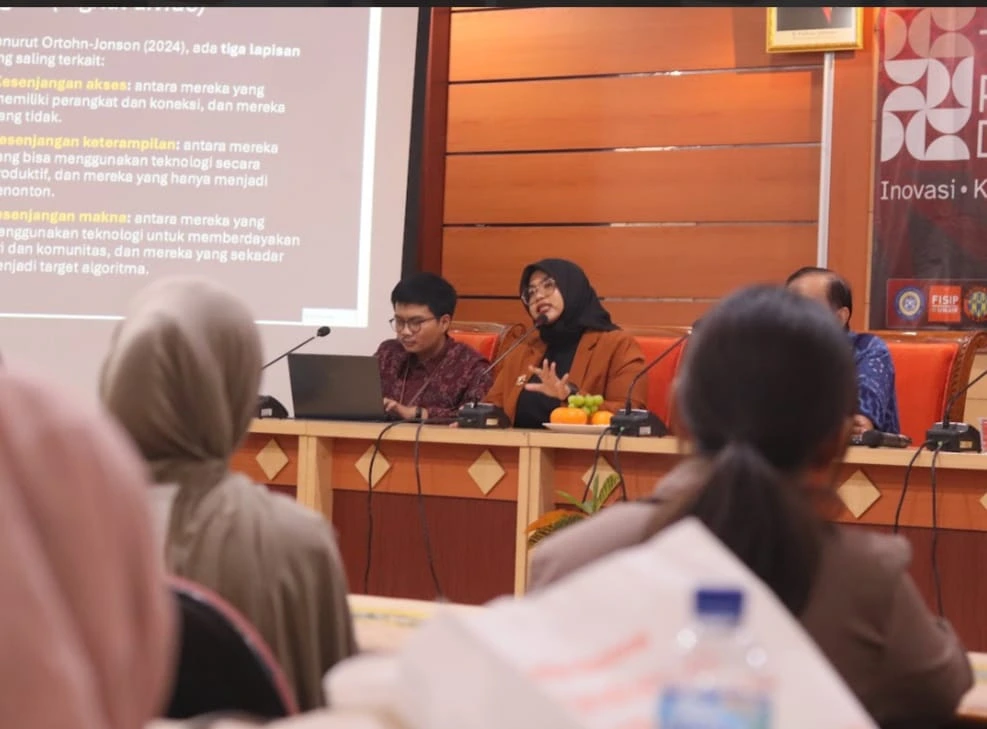
UNAIR NEWS – The Department of Sociology, together with the Sociology Student Association (HIMA) of FISIP UNAIR, successfully organized a National Seminar titled “Digital Development Transformation: Innovation, Collaboration, and Sustainability,” featuring digital development expert Nur Syamsiyah as the keynote speaker.
The seminar focused on “Building Inclusive and Sustainable Digital Development,” examining Indonesia’s digital development trajectory, the persistent digital divide, and strategies to ensure technology serves as a tool for public empowerment. The event, held in the FISIP auditorium on Wednesday (Oct. 22, 2025), drew students, academics, and practitioners from multiple fields.
Digital development is more than technology
During her presentation, Syamsiyah stressed that digital development is not merely a technological initiative. She emphasized that it is deeply tied to power dynamics, unequal access, and social agency. “The central questions we must ask are: who is shaping this development, and who is it designed to benefit? Digitalization is not neutral,” she said.
She pointed to several forms of digital inequality in Indonesia, from digital poverty to the “grey digital divide,” which highlights generational gaps in technology use and access. Factors such as limited devices and connectivity, digital literacy, user motivation, and technical support significantly influence public participation in digital development.
Syamsiyah underscored that meaningful digital transformation must take place both structurally and culturally. This means not only improving technological tools but also reshaping how society interacts, designs policy, and interprets the role of technology. “Digital transformation is not about adding gadgets or expanding networks. It’s about building an inclusive and humane socio-political system,” she noted.
Innovation does not equal social progress
Syamsiyah also cautioned that technological innovation alone does not guarantee social advancement. She argued that progress in technology does not automatically yield progress in society. For that reason, digital development policies must take into account local context, cultural values, and human-centered considerations. A successful digital transition, she added, must empower communities, promote equity, and prioritize long-term sustainability.
In closing, Syamsiyah emphasized that achieving inclusive and sustainable digital development requires comprehensive and collaborative strategies. Digital transformation, she said, should expand opportunities, reduce social inequality, and strengthen participatory democracy. “We cannot wait for technology to evolve on its own. Digital transformation must be shaped collectively so it truly becomes a tool for social justice and humanity,” she concluded.
Author: Saffana Raisa Rahmania
Editor: Ragil Kukuh Imanto