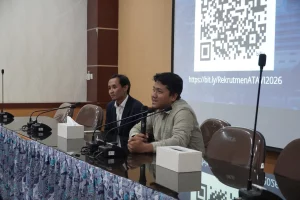



UNAIR NEWS – The Directorate of Career Development, Entrepreneurship Incubation, and Alumni Affairs (DPKKA) at Universitas Airlangga (UNAIR) held a webinar titled From Paper to Pitch: CV, Interview, FGD, and Business Case Skills on Wednesday, July 2, 2025. The event featured Vicky Diestra Rusli, a Senior Talent Acquisition Specialist at Panamas, who provided an in-depth overview of the recruitment process, covering every step from initial application to final interview.
Understanding recruitment journey
Rusli explained that the first stage in any recruitment process is the application, often involving hundreds or even thousands of candidates. “At the application stage, make sure all requirements are met—for example, if there’s a minimum GPA, failing to meet it will result in an automatic rejection,” he said.
He emphasized the importance of standing out in a competitive applicant pool. “A strong CV helps, but it’s not enough on its own. You also need to invest in developing your skills and expanding your network,” she added.
The next stage is the interview, which requires thorough preparation. Rusli advised candidates to focus on their appearance, first impressions, and practice. “Think about your top strengths and biggest achievements. Also, take time to research the role and the company you’re applying to,” he suggested.
Following interviews, applicants often move on to the Focus Group Discussion (FGD) or Leaderless Group Discussion (LGD) phase. “In this stage, you’ll be presented with a case to analyze and expected to offer practical solutions,” Rusli explained.
Business case presentations
He noted that participants naturally fall into different roles during FGDs. “Some become facilitators, others act as note-takers, some debate without offering solutions, and others take on roles like innovators or timekeepers. All roles are valid—as long as they contribute constructively to the discussion,” he clarified.
The final stage typically involves presenting a business case, based on a scenario shared with candidates in advance. “There’s no absolute right or wrong answer in these presentations. What matters is your analytical thinking and how well you justify your recommendations,” he said.
Rusli added that participants are often given datasets and must connect the information effectively. “You need to identify the core issue and propose actionable recommendations for the future,” he explained.
He stressed that this stage demands practice and familiarity with case formats. “Students who regularly participate in business case competitions—both on and off campus—tend to have an edge because they’ve built the necessary experience,” he concluded.
Author: Rizma Elyza
Editor: Yulia Rochmawati