


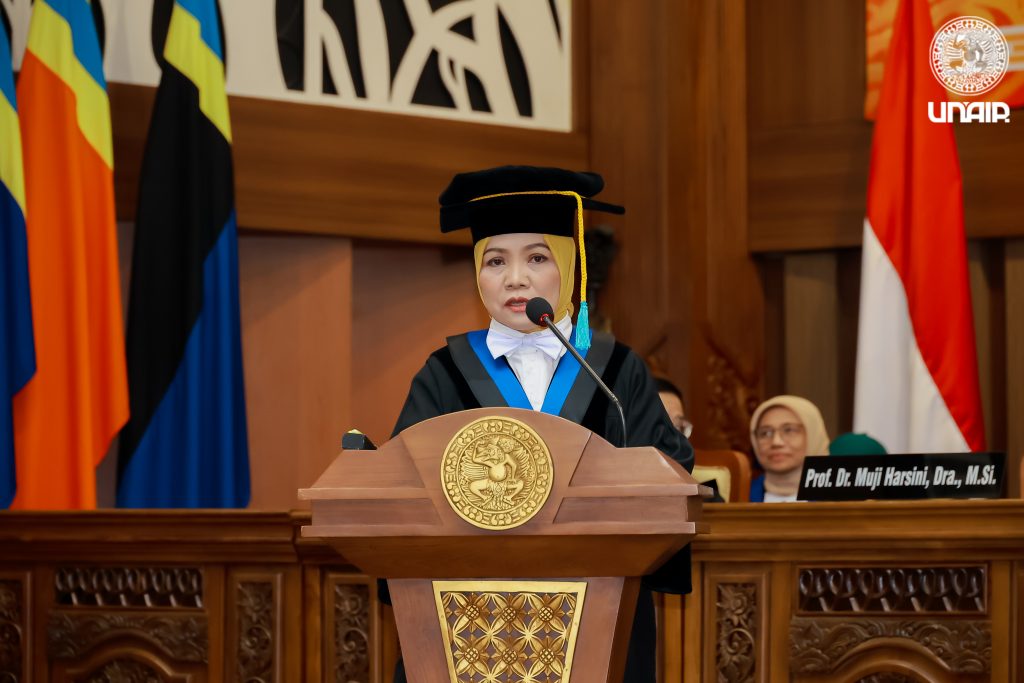
UNAIR NEWS – Prof. Dr. Muji Harsini, Dra., M.Si., from the Faculty of Science and Technology (FST) at Universitas Airlangga (UNAIR), delivered a scientific oration during her formal inauguration as a full professor on Thursday, May 8, 2025. The ceremony took place in the Garuda Mukti Hall at UNAIR’s MERR-C Campus Management Office. In her oration, Prof. Muji Harsini spotlighted electrometry as a vital advancement in the evolution of high-performance chemical sensors. This technology, she emphasized, plays a critical role in improving diagnostics in healthcare, ensuring the safety of cosmetic products, and monitoring environmental conditions.
“Electrometry is a chemical measurement technique that utilizes electric current. It is both precise and efficient, capable of identifying substances in extremely small concentrations,” Prof. Harsini explained. In chemical sensing systems, she added, electrodes are essential for capturing chemical signals. Her research introduces a modified carbon paste electrode (CPE) enhanced with three key materials: nanoporous carbon, polymelamine (PM), and gold nanoparticles (AuNPs).

“Nanoporous carbon provides a wide surface area for effective absorption, PM accelerates electron transfer, and AuNPs significantly boost sensor sensitivity,” she said. The electrode-based sensor developed in her research can detect a range of important substances in biological systems and cosmetic products, including dopamine (DA), uric acid (UA), ascorbic acid (AA), and hydroquinone (HQ). Its strength lies in its ability to identify compounds within complex mixtures, making it highly versatile.
Practical solution for health and environmental monitoring
Prof. Harsini emphasized the practical value of this innovation across several sectors. “With its high sensitivity, this electrode can be applied in routine clinical diagnostics, cosmetic safety evaluations, and environmental monitoring,” she noted.
The electrode is also environmentally sustainable, as it does not rely on toxic materials such as mercury. Additionally, the components are inexpensive and easily modified, making the technology widely applicable and affordable for broader public use.
“This innovation is not only a scientific achievement—it represents a meaningful contribution from the lab to society. Our hope is that this chemical sensor becomes a reliable, safer, and more accessible tool for public benefit,” Prof. Harsini concluded.
Author: Febriana Putri Nur Aziizah
Editor: Yulia Rohmawati