

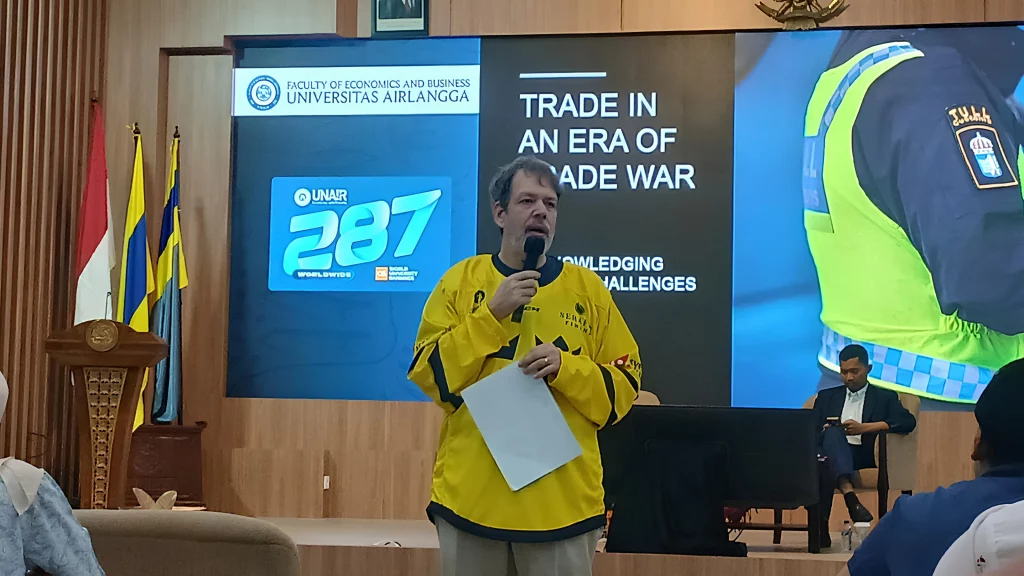
UNAIR NEWS – The evolving landscape of global trade was the focus of an international guest lecture held by the Faculty of Economics and Business (FEB) at Universitas Airlangga (UNAIR), featuring Swedish Ambassador to Indonesia, Daniel Blockert. In his address, Ambassador Blockert discussed current global trade trends and highlighted opportunities to strengthen economic cooperation between Sweden and Indonesia
Speaking at Fadjar Notonagoro Hall, Campus B-Dharmawangsa, Ambassador Blockert noted that although Sweden is roughly the size of Sumatra, it is home to globally recognized companies such as Volvo and IKEA. He explained that this success is closely tied to Sweden’s reliance on international trade. Against the backdrop of rising geopolitical tensions and a weakening global trade system, he underscored the importance of openness and international collaboration.
“Sweden’s economy is highly dependent on trade. More than half of our GDP is generated through trade, and we operate as an open economy. We also take a different view of imports, nearly one-third of the value of our exports actually comes from imported inputs,” he said.
Global trade challenges
Ambassador Blockert emphasized that Indonesia needs to balance its pursuit of self-sufficiency with efforts to attract foreign investment, particularly in an increasingly complex geopolitical environment. He argued that maintaining openness and strengthening integration into global supply chains are critical to sustaining investment flows. He also pointed out that complete self-sufficiency, especially in food production, is not a realistic objective for any nation.
“Certain strategic sectors may require greater independence, such as energy and food security. However, achieving total food self-sufficiency is not feasible, neither for Indonesia nor for Sweden,” he said.
Health sector collaboration
Ambassador Blockert further highlighted doctoral programs and joint research initiatives between Sweden’s Karolinska Institutet and Indonesian universities as examples of successful academic cooperation in healthcare. He noted that the health sector illustrates how global supply chains and trade policies can directly influence access to vaccines, medicines, and medical technologies.
“In the early phase of the pandemic, many countries experienced limited access due to market closures and disrupted trade flows. Over time, conditions improved, and Indonesia has since strengthened its vaccine production capacity. UNAIR was among the institutions that contributed to the development of COVID-19 vaccines,” he concluded.
Author: Kania Khansanadhifa Kallista.
Editor: Ragil Kukuh Imanto